












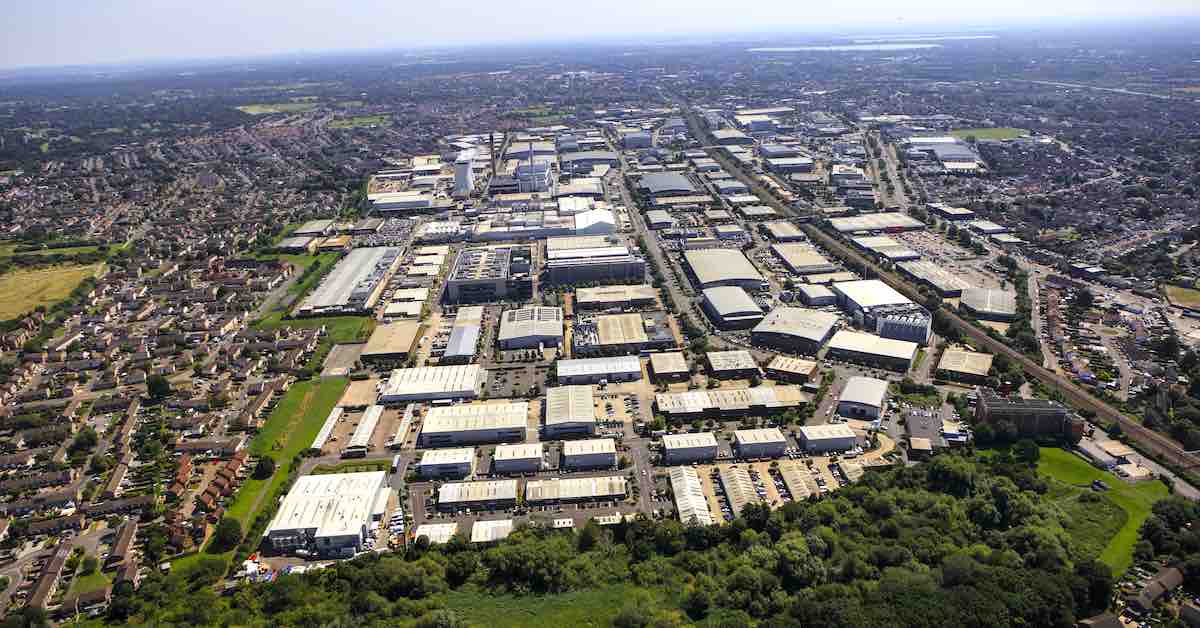
Jo Jackson, director Thames Valley for SEGRO, explains the remarkable significance of the data centre cluster at Slough Trading Estate and the factors which support its success.
As the UK accelerates towards an AI-enabled, cloud-first economy, the question is no longer whether digital infrastructure matters, but where and how it should be scaled.
Data centres have become critical national infrastructure, but their success depends on concentration, connectivity and confidence, not isolated development.
Slough Trading Estate’s emergence as Europe’s leading data centre cluster did not happen by accident. It offers practical lessons from developing and operating cloud data centres at scale, showing how Availability Zones form when long-term land strategy, an appetite to invest and governance align.
Availability Zones are separated groups of one or more data centres, with multiple Availability Zones forming an availability region. They’re designed to back each other up, so if one Availability Zone has an issue, another Availability Zone from the same provider can keep things running. Slough is an Availability Zone and continues to be a hugely attractive location for data centre investment.
Slough Trading Estate has continuously adapted to the needs of its time. In the 1910s it emerged as a centre for light industry to serve London’s growing population; by 1950, it was dominated by heavy manufacturing, producing machinery and vehicles for both domestic and export markets. Today, it is home to 350 businesses of all sizes, including the data centre cluster.
If there is a single catalyst behind Slough’s growth, it is connectivity. Strategically positioned on the key fibre cables linking London to North America, it offers unparalleled connections between these two large population and financial centres where milliseconds count.
For data centres, this structural advantage cannot easily be replicated and explains why operators, particularly those facilitating cloud-based services and inference AI, chose to establish themselves there initially and continue to expand.
Data centres benefit from proximity to each other. It enables operators to leverage economies of scale and attract and harness a specialised workforce. Today, the Slough Trading Estate is host to many major global operators, forming one of Europe’s densest and most mature data centre clusters. This clustering creates a self-reinforcing cycle where more operators attract more customers, which attracts more investment, which attracts more operators and skilled workers.
Beyond its geographic location, there are other significant factors that have enabled the Slough Trading Estate to establish itself as a leading data centre hub. As Europe’s largest industrial estate in single ownership, it has a unique opportunity for active land management, consolidation of opportunities and planning years in advance, which are advantages that sites in fragmented ownership cannot match.
In addition to this, it has access to power and the trading estate also benefits from a recently renewed Simplified Planning Zone (SPZ), which means that for the next 10 years development can move forward with planning certainty and with a significantly quicker speed to market without needing specific planning consent, as long as the proposed development is within agreed parameters.
Governance has been equally important. A single local authority that understands the sector and the advantages it brings far beyond the immediate estate has been fundamental. Slough Borough Council recognises the value of data centres for the wider economy, for example across construction, engineering and maintenance. There is also a growing local supply chain.
For example, a company called ATC, which specialises in complete data centre solutions, from transport and logistics to installation, took 20,000 sq ft of space on the Trading Estate last year to service the cluster. The estate also accommodates space used by a major global hyperscaler for the storage and servicing of its own equipment that supports its wider data centre operations in the area.
A focused data centre cluster helps with the planning and funding of supporting infrastructure, in particular power. Power is a challenge facing every mature European data centre market and as AI workloads intensify and data centres become more prevalent, demand for electricity will also grow.
Meeting that demand cannot be left to individual operators or local authorities alone. It requires a coordinated national response, bringing together government, National Grid, system operators, regulators such as OFGEM and investors to anticipate demand and deliver infrastructure at pace.
If the UK wants to remain globally competitive for digital investment, it must not treat data centres as standalone developments. The Government’s emerging AI Growth Zones point in this direction, but their success will depend on translating policy ambition into coordinated delivery across power, planning and long-term land strategy. Capital, talent and innovation follow certainty of power, planning and long-term strategy.
Slough Trading Estate shows what is possible when those foundations are in place. The lessons learned from building and operating one of Europe’s most mature cloud and AI data centre clusters offer valuable insight as AI Growth Zones seek to develop data centres as innovation hubs rather than standalone assets.
For policymakers shaping industrial strategy and investors allocating long-term capital, the UK’s digital future will be enabled by continuing to grow established Availability Zones as well as curating new clusters of data centres where connectivity, land and governance converge, and where national infrastructure planning keeps pace with digital ambition. Places like Slough.
© Thames Tap (powered by ukpropertyforums.com).
This article and its contents are the intellectual property of UK Property Forums and may not be reproduced, distributed, or used in any form without prior written permission. The views expressed are those of the author(s) and do not constitute legal or professional advice.