













Richard Shuldham, associate director, Savills Norwich, comments on the Norfolk development land market.
There is considerable variation across Norfolk’s development land market with stronger interest for ‘oven ready’ sites in well-connected locations tempered by a dip in average values, agents have said.
Richard Shuldham, associate director in the development team at property firm Savills in Norwich, said fewer sites came up for sale in the county last year as many landowners assessed their options.
According to Savills research the value of greenfield sites in the East of England has fallen by an average of 1% in the last year – compared to a drop of 1.4% for the UK. The value of development sites in more urban locations meanwhile has fallen by an average of 2.6% – compared to an average drop of 4.5% for the UK.
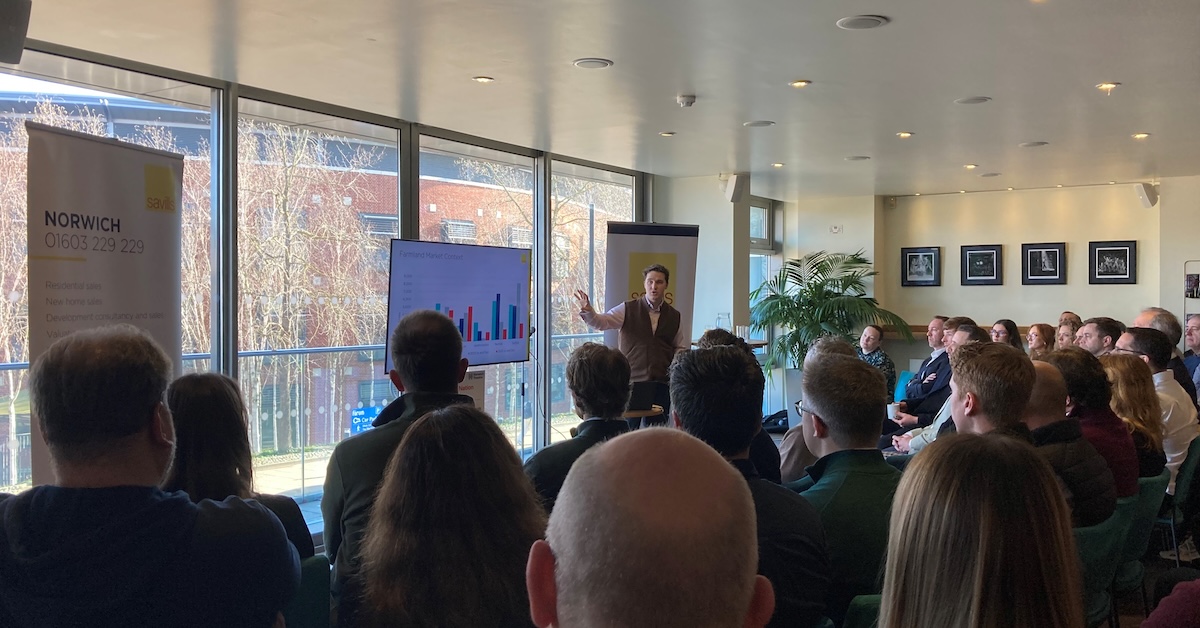
Richard was speaking at a recent breakfast seminar hosted by Savills at Norwich’s Theatre Royal attended by developers, housebuilders and affordable housing providers.
“The uncertainty caused by the Autumn Budget meant that many landowners decided to sit tight last year and assess their options – so there hasn’t been a flood of land coming to the market,” he said.
“This exacerbated an already reduced supply caused by planning permissions being delayed by nutrient mitigation requirements. As a result, values for easily deliverable sites have held up relatively well – although there’s a lot of variation.
“Sites that are ‘oven ready’ – where planning permission is already in place and there’s a good level of local infrastructure, particularly close to arterial routes – have generated competitive bidding. However, demand for sites in secondary locations – anything perceived as slightly less than ideal in terms of planning permission and road networks – has been more challenging. This has been compounded by slower sales of new build properties and limited house price inflation.”
Richard said fewer new build sales and higher costs meant larger housebuilders were often better placed to continue operations, while pressures on smaller independent builders were more acute.
“SME developers are generally delivering homes at a slower pace and therefore have limited capacity to invest in new opportunities,” Richard said. “Norfolk is a county that is more reliant on these builders, so new home delivery has slowed down considerably.”
Richard said he expected Norfolk’s development land market to remain price sensitive and that housebuilders needed to be understand the motivations of local landowners.
“Competition for well-located, high-quality sites should remain strong due to restricted supply – with housebuilders carefully gauging market sentiment,” he said.
“We may see a pickup in activity from housing associations once funding from the new Social and Affordable Homes Program is allocated, while appetite for longer term strategic sites should also remain robust as developers look at opportunities created by revised planning policy. Any indication of a government backed buyer incentive scheme to replace Help to Buy would also likely lead to a stronger market.
“Whatever happens it is important for housebuilders to understand the motivations of local landowners. For many it is not just a purely business decision – the land has been in their family for generations so there is a sense of legacy and wanting to benefit the local community. Greater flexibility may well be required in structuring agreements to ensure they reflect the landowner’s long-term vision.”
Images: Savills
© Eastern Echo (powered by ukpropertyforums.com).
This article and its contents are the intellectual property of UK Property Forums and may not be reproduced, distributed, or used in any form without prior written permission. The views expressed are those of the author(s) and do not constitute legal or professional advice.