











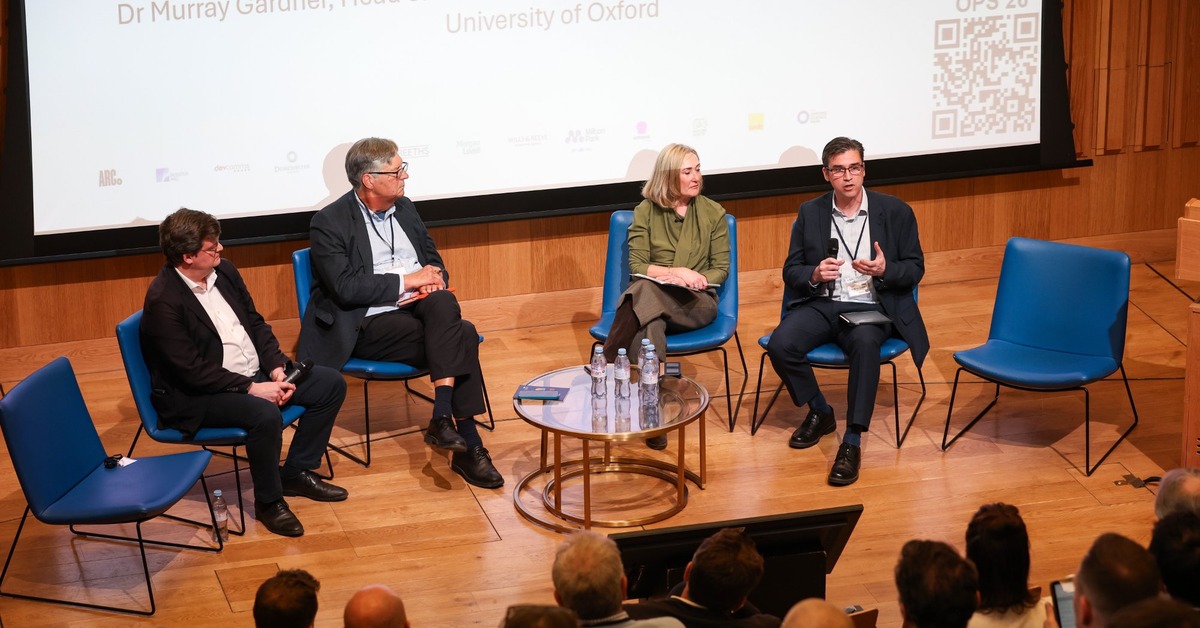
The fifth session of the day discussed information needed to evaluate Oxfords potential as an investment opportunity.
The session was chaired by Sarah Haywood, managing director at Advanced Oxford.
Claus Andersen, partner and head of life sciences at Freeths, was asked about issues for attracting clients, he went on to say that he found the UK to be fairly easy to do business within, due to factors such as the rule of law, and Oxford specifically is strong in STEM sectors, with: “good access to talent.”
In terms of issues, he cited that: “from a distance, Oxford can look a bit fragmented” and that affordability is an issue, also saying that there was a: “general infrastructure challenge” in the area.
Jens Tholstrup, executive chairman at OION, was asked to talk about the Oxford Innovation Space and its challenges, he said “It’s a brilliant ecosystem to be part of”, however he cited a big issue, that being access to capital, which he found to be disproportionately weighted in Oxfords favour, yet still not enough, he asked: “How do we attract more capital into this ecosystem?”.
The audience asked the panel questions, notably one enquired as to whether OSE (Oxford Science Enterprises) was finished, Dr Murray Gardner, head of strategic engagement and regional partnerships at the University of Oxford, responded that this wasn’t the case, however OSE aren’t able to service all capital needs from the University, and need additional funds.

The sixth session discussed new Oxford districts, and whether the Cowley Branch Line could aid in their growth
This session was chaired by Emily Slupek, director building and project consultancy at Savills.
Darryl Chen, lead of urban design and project consultancy at Savills, opened the session by envisioning four different scenarios for Oxford:
- Scenario one: Oxford is a victim of success, with rapid exposure of identified growth centres, and new capacity in the historic city centre
- Scenario two: Oxford is stable but not world leading
- Scenario three: Oxford is elite, but unequal, and suffers from fragmented leadership
- Scenario four: Oxford experiences mounting dysfunction, and neighbourhoods lose distinction
Tom Bridgman, deputy chief executive of place at Oxford City Council, added that he felt the Cowley Branch Line will be a game changer for Oxford.
Simon Ruck, managing director at Oxford North, said focusing on great design, open spaces, and building open plan was a good route to take, as it would help retain the best talent and create a home for innovation.
Mr Ruck, who recently featured on our podcast, cited his Oxford North development as an example of a space with different uses, notably the 2 acre park situated near the laboratory and commercial buildings.
The panel were optimistic about new Oxford districts, referring back to EIT, with Mr Ruck saying: “big business leads to great opportunities”, and Mr Bridgman quipping: “If it had gone to Cambridge, we’d be upset”.
The last session of the day was focused on how Oxfordshire could make the right connections, especially focusing on infrastructure delivery.
The session was chaired by Sebastian Johnson, director of ecosystems at ARC Harwell.
Dr Martin Reeves, chief executive at Oxfordshire County Council opened the session by directly discussing infrastructure, outlining that there had been steady progress over the last three years, but there was still more to do, with significant challenges along the way.
Dr Reeves continued, discussing the Oxrail plan, which aims to reconnect Oxfordshire to the rest of the country, Dr Reeves believed the scheme was: “universally welcomed”.
Eleanor Wills, senior business case and commercial lead for Green Railway for Growth- Great Western Railway, said: “Rail is the transport solution for this country”, and followed this up by saying: “we have to think in a whole-systems way”, she focused in on rolling stock availability, as she believes the Government needs to support GWR with additional vehicles.
Jeya Sivasubramaniam, director, major projects and portfolio at SNRG, spoke further on the whole-systems approach, saying: “Maybe we don’t have a power problem, maybe we’re just not scratching below that B&O surface”, continuing on the topic, he said: “We need the help of architects, and we need asset managers”.
The panel then answered questions, and when asked where innovation gets blocked, Ms. Wills responded by saying: “we work in an industry that’s heavily subsidised, there isn’t the money there”.
Dr Reeves responded by saying that friction was the worst barrier in his opinion, and that more connection was needed, and that the focus needed to shift from what can be done, rather than what can’t, he added: “Mayors make themselves by their nature a nuisance every day, and that makes things happen, amplify that voice”.
Read the morning sessions for the Summit here
See our photo gallery for the day here
© [2026] UK Property Forums. All rights reserved.
This article and its contents are the intellectual property of UK Property Forums and may not be reproduced, distributed, or used in any form without prior written permission. The views expressed are those of the author(s) and do not constitute legal or professional advice.