












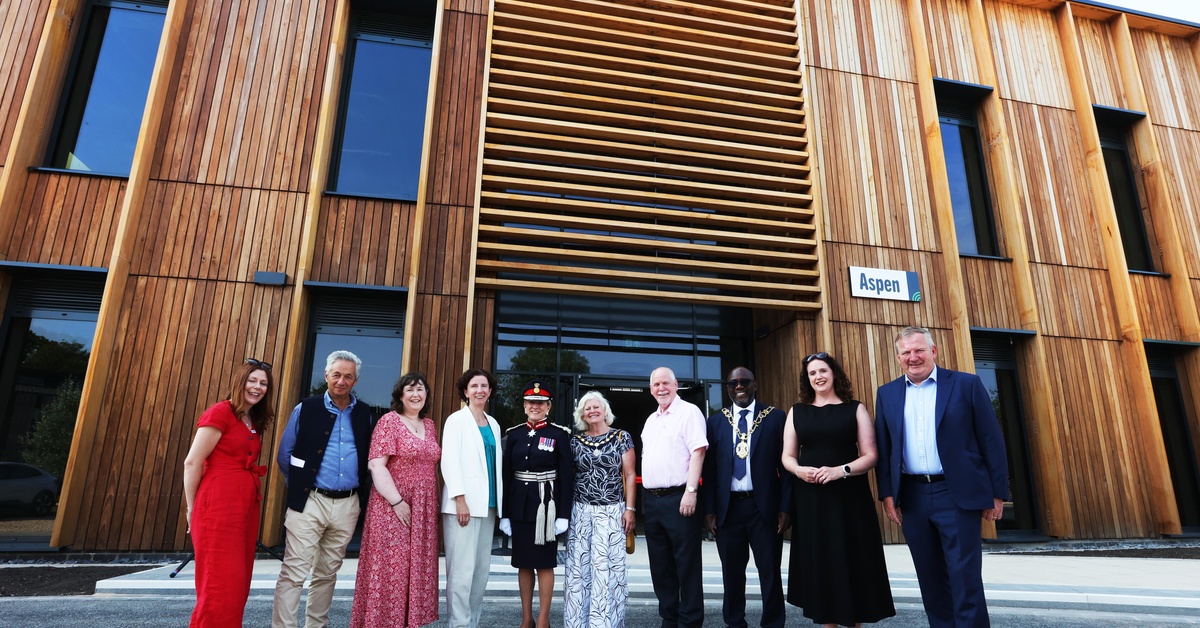
The Oxford Trust has officially opened its new £9 million Aspen Building at the Wood Centre for Innovation in Headington. Alfie Morse attended the opening event last Friday, speaking to members of the Trust about what the building means for them, and Oxford as a whole.
Opening event
The new 17,000 sq ft facility was formally opened by Rt. Hon. Dame Anneliese Dodds MP, Member of Parliament for Oxford East and attended by Mrs Marjorie Glasgow BEM, His Majesty’s Lord-Lieutenant of Oxfordshire, leader of Oxford City Council councillor Susan Brown, vice chair of Oxfordshire County Council councillor Roz Smith, the Lord Mayor of Oxford councillor Chewe Munkonge and Mark Beard, chairman of Beard Construction.
The event brought together representatives from Oxford’s science and innovation community, business leaders, partners and stakeholders.
Located in Headington’s health and life sciences cluster, the Aspen Building provides two floors of CL2 laboratory and office space for science and technology start-ups, SMEs and scale-up businesses.
The development also includes a dedicated STEM resources room that will enable The Oxford Trust to expand its science engagement and outreach activities across Oxfordshire and Buckinghamshire, delivered by Science Oxford.
Designed with sustainability at its core, the Aspen Building has been awarded BREEAM Excellent certification and will deliver at least 10% Biodiversity Net Gain across the surrounding woodland site. Environmental features include photovoltaic roof panels, battery energy storage, air source heat pumps, rainwater harvesting and enhanced landscaping to support biodiversity.
The Aspen Building was delivered by construction partner Beard and has already generated significant economic value during its construction, supporting approximately 600 jobs over the project, including 80 local jobs, and one apprenticeship across the project and supply chain.
Once fully occupied, the Aspen Building is expected to support the creation of up to 80 additional jobs, further strengthening Oxford’s position as a leading destination for scientific discovery, innovation and entrepreneurship.
The Aspen Building sits alongside the fully occupied Linden Building at the Wood Centre for Innovation and further enhances The Oxford Trust’s ability to support high-growth science and technology businesses while generating long-term social impact through science education. The Linden Building is home to 10 pioneering life science and deep tech startups including DJS Antibodies, PicturaBio, Lumai, Exogene, Jack Fertility, Pure Capture, Densix, Helio, Bioarchitech and Newrotex.
Interview
Alfie spoke to two key figures at The Oxford Trust – Steve Burgess, chief executive, and Nicki Campling, innovation & operations director:
Q: Today is a major milestone for The Oxford Trust, what does the Aspen Building represent in the wider evolution of the trust?
Steve: “The Trust has been around for 40 years…and it was formed on the basis of helping startup companies get started in Oxford, the first innovation centres that it had were the first in the UK, so this is a continuation of that timeline, but in a much grander setting…it joins the Linden Building on the other side of the site, creating 40,000 sq ft of very high quality lab and office [space]…in a very rural setting, but still close to the city”.
Nicki: “It expands our offering, in terms of the Oxford Trust mission, not just from an innovation perspective, in terms of providing growing space, which is something that whilst Oxfordshire benefits from a lot of development at the moment – I’m not sure that there’s much growing space, a lot of it seems to be scaling space.
“In addition to that, we have our STEM outreach programming, and our fantastic team that delivers those programmes to those schools and those communities who simply don’t have the budgets to get their children to our centre, so it provides a fantastic space for them to grow their offering, flex their programming…deliver and have a lot more impact”
Q: This building contains CL2 laboratories, how important is that specific kind of lab space for this cluster?
Steve: “I think it’s very important to have a flexible use space of CL2 standard, it’s not that everyone coming into this centre is going to necessarily be bioscience, we have companies in AI also requiring CL2 because they’ve got lots of very sensitive equipment…We’ve got them in diagnostics, we’ve got them in material science, and of course bioscience”
Q: Sustainability is a priority, with photovoltaic panels and BNG features, how does that shape the project?
Nicki: “It’s key to the ethos of The Oxford Trust in how we inspire the next generation, sustainability I think is one of the key areas – particularly in light of the extreme weather conditions and extreme climate we’re operating in, so we want to be mitigating our carbon footprint to the best of our ability, we have 15 acres of natural realm that helps us with that, but in addition we’ve built integral design into the Aspen Building including PV…we have rainwater harvesting… we have lots of design systems that are fitted to mitigate energy…it’s integral in everything that we do
“We’ve achieved BREEAM Excellent with an 11.7 per cent tolerance, we were targeting 75 per cent, we’ve actually hit 87.4 [per cent]”
Q: This building will include a dedicated STEM resources room, how does that reflect The Oxford Trust’s mission?
Steve: “The Oxford Trust was set up originally to do entrepreneurship and startup companies in tech, but very soon after Lady Audrey Wood, who was a school governor, really started to push the educational aspects having seen how poor science teaching was – particularly at primary school – so we quickly developed a programme around that STEM enrichment activity.
“This is basically another iteration of that, that allows us to visit hundreds of schools in Oxfordshire and Buckinghamshire at a very cost-effective price to schools, because money is tight in all of the schools, the model that we have here where the surplus comes from our innovation centres – basically powers the STEM education.
“We don’t have shareholders, we don’t have stakeholders that require their money back, it all goes back to create the next generation of scientists and entrepreneurs.”
Q: “Once this building is fully occupied, what does success look like five years from now?”
Nicki: “Success looks like growing companies that have not only had an impact, but outgrown us so that we can free the pipeline for the smaller, earlier stage companies to come through the Wood Centre for Innovation.
“[It’s a] family site, so from the incubators, into our existing building, with smaller space, moving through into the new Aspen Building when they’re growing, to the happy event of them graduating because they are scaling, that for me is success.”
Image: (l – r): Nicki Campling, director of innovation and operations, The Oxford Trust, John Boyle, chair of trustees, The Oxford Trust, Cllr Susan Brown, leader of Oxford City Council, Rt. Hon. Dame Anneliese Dodds MP, Mrs Marjorie Glasgow BEM, His Majesty’s lord-lieutenant of Oxfordshire, Cllr Roz Smith, vice chair of Oxfordshire County Council, Steve Burgess, chief executive, The Oxford Trust, Cllr Chewe Munkonge, lord mayor of Oxford, Francesca MacLennan, director of science education and engagement, The Oxford Trust, Mark Beard, chairman, Beard Construction. Credit: The Oxford Trust, photos by Ed Nix

© 2026 UK Property Forums. All rights reserved.
This article and its contents are the intellectual property of UK Property Forums and may not be reproduced, distributed, or used in any form without prior written permission. The views expressed are those of the author(s) and do not constitute legal or professional advice.