











On Monday 14 September, the Oxfordshire Developers Forum convened at The Oxford Science Park to discuss the latest emerging factors influencing Oxfordshire’s property development. Alfie Morse reports.
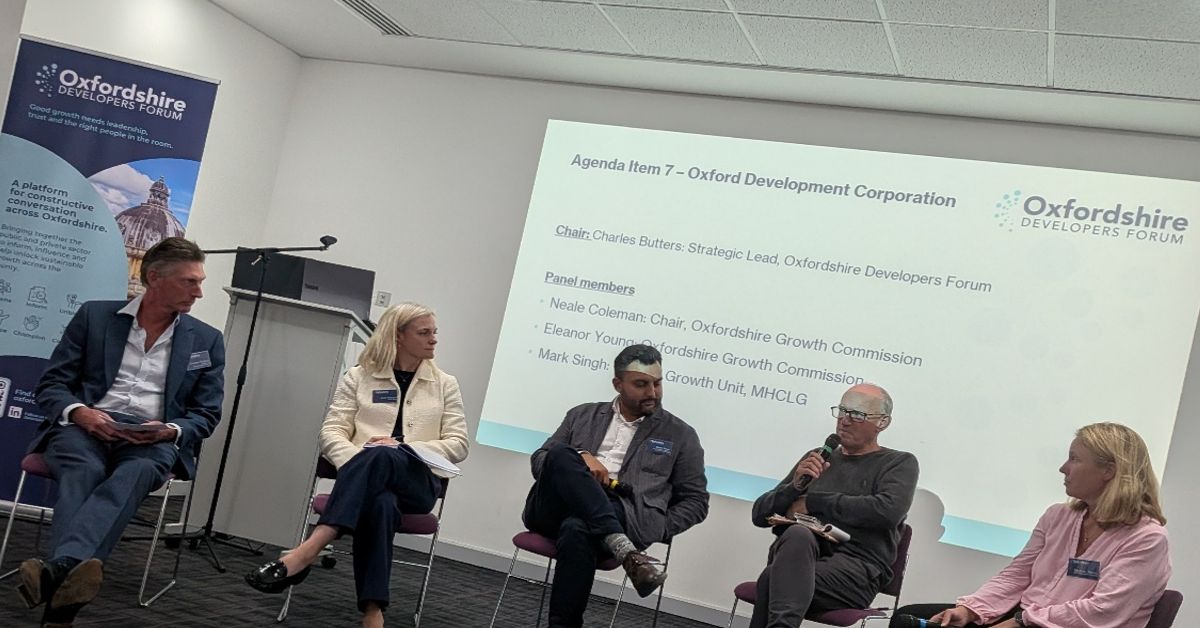
Mondays key event was the panel session, chaired by Charles Butters, Oxfordshire Developers Forum strategic lead, which featured:
- Neale Coleman, chair of the Oxford Growth Commission (OGC)
- Mark Singh, assistant director at the Ministry of Housing, Communities, and Local Government
- Eleanor Young, director at Blackstock Partnership
- Julia Krause, regional assistant director at Homes England
The session opened with an introduction from Neale Coleman, where he mentioned the progress OGC were making with their final report, describing it as being: “Fairly advanced”, with expectations of the report being made public in either October or November of this year.
Mr Coleman went on to mention that the report would: “Amongst other things…look in some detail at where we’re going on the [Greater Oxford] Development Corporation”.
The recent pause on LGR decisions was also mentioned, and Mr Coleman said that the OGC was: “Still firmly focused on what we understand the government wants to do, which is to consult on the creation of the Greater Oxford Development Corporation” in spite of the news.
Figures surrounding Oxfords strong economy were also mentioned, in the first half of this year, Oxford spinouts raised €908 million for their expansion, which was more than all of Germany’s spinouts, also representing 20 per cent of all funding raised across Europe, this data was described by Mr Coleman as a reflection of: “A firm view that we have…that encouraging further growth particularly in the innovation economy is an issue of…national significance for the UK and the UK economy”.
The established Greater Cambridge Development Corporation was also discussed, as many of the consultants involved in the establishment of the Cambridge Develompemnt Corporation are now involved in the evidence base for the Oxford Development Corporation.
Deloitte was mentioned to be working on issues around governance and structure for the DevCo, whilst AECOM were performing work on infrastructure – which Mr Coleman described as: “Building on the work they did in developing the Oxford infrastructure strategy for the County and indeed the districts”
Mr Coleman described this work as enabling the OGC to come to a view on: “An evidence-based rationale for the geographical area for the Development Corporation, within which it should function, and also the powers that we think the Development Corporation should take”
A key announcement was then made, with Mr Coleman saying: “It is still our aim to get the consultation document out this year, with a view to getting the Development Corporation fully running in shadow form during next year…and then established with its powers in early 2028”
The intention was said initially to be to vest the Development Corporation alongside the new unitary authorities for Oxfordshire, however Mr Coleman said he thought this was now unlikely, though the OGC’s position was that there was an ‘overwhelming case’ for the unitary authorities, and mentioning that the Commission was also pushing for: “As rapid progress as possible” on the creation of a Mayoral Strategic Authority for the Thames Valley.
Mr Butters opened the questions on the topic of the proposed Development Corporations interventionist capabilities, by asking: “How will some of those interventions, and some of those workstreams be financed and funded?”
Mr Coleman responded: “There’s no point in having a Development Corporation unless we have a financial framework agreed with central government, that’s going to generate the money we need both for investment in infrastructure and for land assembly, there’s a range of conversations going on around exactly how that will work…We’re fortunate in that to some extent we’re in the wake of Cambridge”
Mr Singh added: “The funding comes from a mixture of grant funding from central government, from FT loan money from central government, money from the National Housing Bank, through the National Wealth Fund…and other financial mechanisms”
Paul Mumford, director at GummerLeathes, asked about the possibility of moving the Oxford sewage treatment works, Mr Coleman responded: “We think that there are some very strong arguments [for] why moving sewage treatment works would be desirable for maximising both housing and economic growth in that area…We are actively talking to Thames Water about the issues with the sewage treatment works”
David Bell, director at LDA Design, then asked about the role of the OGC in either setting strategy, or delivering strategy set by a Spatial Development Strategy (SDS).
Mr Coleman expressed his personal view that progress with the SDS was ‘Critically important’, and that without a mayor he believed it would be difficult to achieve an SDS that would provide a framework for development, also adding that he believed it was likely that early in the OGC’s existence that there wouldn’t be an effective SDS, or potentially even an SDS at all.
Eleanor Young added with perspectives from a roundtable held earlier that day, specifically on the role of housing in supporting economic development, mentioning companies leaving the area and moving to London due to an inability to house staff, saying: “It’s about making the whole system work better, and getting those homes close to where the jobs are is the real focus…if we can just do what’s in the plan, that would be a really strong start”
Phillip Campbell, commercial director at Milton Park, asked about the likelihood of Oxfordshire being part of either a mayoral or foundational strategic authority, and the importance of the former.
Mr Coleman said: “We should aim for the quickest possible route to a mayoral strategic authority, but we don’t need an interim foundation authority…I think you could do it by 2028 but it would be unprecedentedly quick action…certainly 2029 would be a reasonable thing to go for…for these very strong economies you need a mayor to come in and take a grip of that”
Anna Strongman, chief executive of OUD, made a request that the OGC continue to have an impact through convening power and holding a mirror up to the development community, and then asked what developers could do themselves to support the OGC.
Mr Singh mentioned the OGC would end in November, with interim arrangements coming together between the establishment of the Development Corporation, which he said should exist in statute form in some capacity next summer, adding that the interim board would be: “Still informed by the same kind of people that the growth commission was made up of”
Mr Coleman responded by outlining what developers could do: “Pace, talk to people, open conversation particularly with the districts…we’ve often had to get involved in conversations and brokering them between some of the districts”
Julia Krause said: “We don’t have to wait for this to take effect, if there are projects that need our support then we are absolutely here to help…get in touch with us, communicate with us…don’t assume we know about what’s going on about particular issues”
The session was concluded by Robin Rogers, director of economy and place at Oxfordshire County Council, who mentioned that the meeting was the last of ODF’s formal sessions for the year.
The next ODF gathering will be at Rhodes House on December 7, for a recap of the year. Speaking sessions will resume in spring of 2027.
Image: Pictured (l-r): Charles Butters, Julia Krause, Mark Singh, Neale Coleman, Eleanor Young

© 2026 UK Property Forums. All rights reserved.
This article and its contents are the intellectual property of UK Property Forums and may not be reproduced, distributed, or used in any form without prior written permission. The views expressed are those of the author(s) and do not constitute legal or professional advice.