










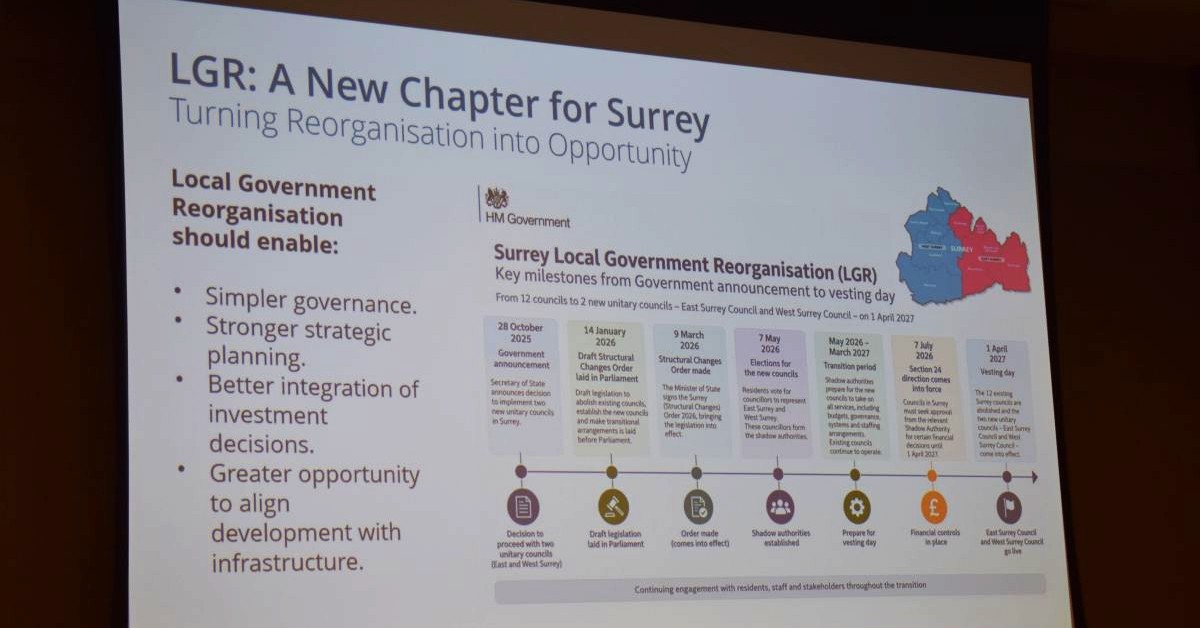
Across the morning’s speakers, one message was consistent: the change is not just administrative, but a chance to reset Surrey’s future.
Local government reorganisation (LGR) is likely to reshape Surrey by changing who makes decisions, how investment is directed, and how growth is planned.
- Change as an opportunity
“The creation of two unified councils should not be viewed as an administrative exercise should give you an opportunity to rethink how decisions are made.”
John Tarvit, director of planning, Wates Developments, framed LGR as a moment to modernise governance. His key point was that Surrey should not simply reorganise structures; it should use the transition to improve planning, infrastructure delivery, and accountability. In practice, that means stronger links between development ambitions and the infrastructure needed to support them, including schools, transport, healthcare, digital connectivity, and green space. The change could also make Surrey more attractive to investors if it results in clearer priorities and a more stable operating environment.
- Transition, stability, and financial pressure
“That process is something we call transition. It is not transformation; we have to make sure that everything still works on day one.”
Steve Wotton, leader of East Surrey Council, stressed the practical challenge of making the new councils function smoothly from the start. His focus was on continuity: ensuring services keep running while new systems are bedded in. But he also pointed to the financial reality behind the reorganisation. Surrey’s councils face flat cash settlements and inflationary pressure, so growth becomes essential to long-term resilience. In his view, LGR should help unlock economic opportunity, retain more business rates locally, and create a stronger base for future services.
“We are on something new, and we’re very keen to make sure we establish a new culture from the start.”
That new culture matters. LGR is not only about redrawing boundaries; it is about changing how Surrey works with residents, businesses, and neighbouring areas. Steve also highlighted the importance of pride in place, town centres, and partnership working to bring communities with the change rather than imposing it on them.
- Strategic planning and investor confidence
“The important question is whether Surrey can move stronger, whether it can deliver better outcomes for residents, businesses and communities.”
Catriona Riddel, director at Riddel Associate, explained that Surrey’s biggest impact from LGR may come through planning reform and strategic authority powers. She argued that Surrey needs a clearer, more stable planning framework to rebuild confidence among developers and institutional investors. She said investors want certainty, and that the new strategic authority model, especially with mayoral powers, could provide it.
“If I’ve got a spatial diagram of Surrey that tells me over the next 20, 30 years how it’s going to change… that’s enough to give them the confidence to invest in a place like Surrey.”
That captures the core issue: LGR could help Surrey present a coherent long-term vision. If done well, it may improve housing delivery, infrastructure planning, and cross-boundary collaboration. If done badly, it could simply add complexity. The prize, however, is significant: a more joined-up Surrey with stronger growth, better services, and a clearer future direction.

© 2026 UK Property Forums. All rights reserved.
This article and its contents are the intellectual property of UK Property Forums and may not be reproduced, distributed, or used in any form without prior written permission. The views expressed are those of the author(s) and do not constitute legal or professional advice.