












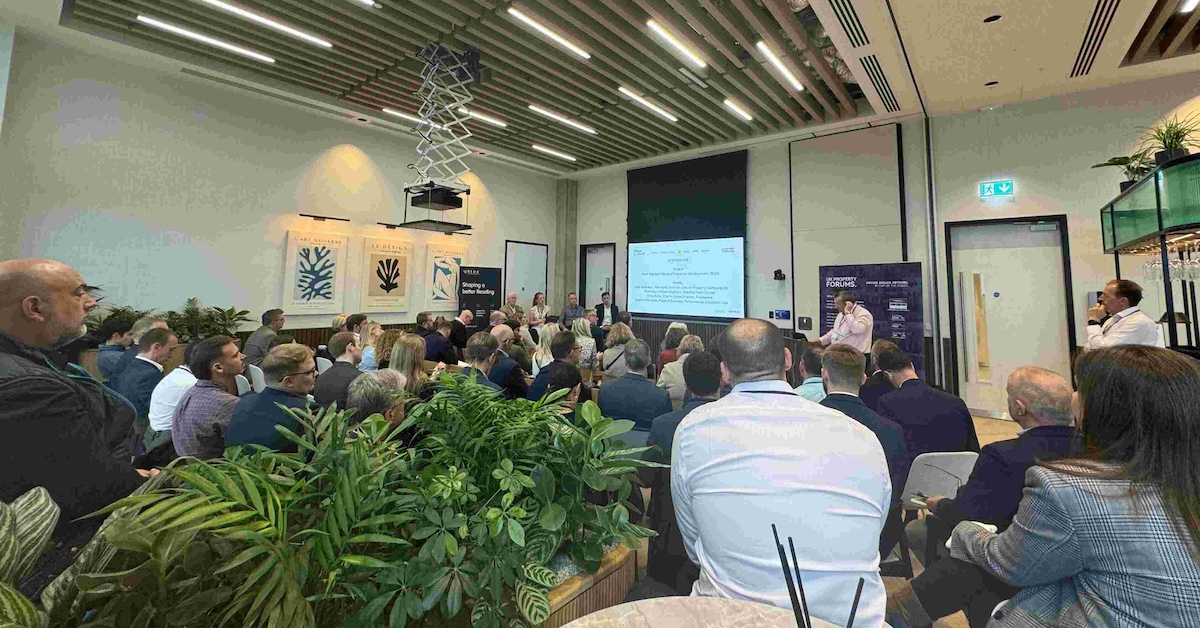
Alan Bunce offers a personal summary of highlights from BerksProp Summit 2025, a morning of debate and information.
Normally in a conference, you expect the main headline to be around the middle or the end. It doesn’t normally come in the short briefing session, designed as a forerunner to the main show.
But after Michael Garvey MBE gave an unvarnished view of the Reading office market we just had to report that in a separate story. An entertaining session of blunt truth which will provoke thoughts in many.
However, it should be contrasted with Guy Parkes’ research-led presentation which showed two massive years for Reading’s office market and the fact, reported by Dan Channer, that Haslams had had its best ever year of residential sales.
And so to the conference, attended by almost 100 delegates.
Session one – Changing Places
After a speech by Bracknell MP Peter Swallow, he joined a debate on devolution in which he made clear the South East had, for years, been left to get on with it by Governments as far as its own prosperity was concerned, because it has been so successful.
However, he argued there is much untapped potential because there had been a lack of support. He said devolution offers the required help.
Emma Gee, executive director economic growth & neighbourhood services for Reading Borough Council, argued that coming together of neighbouring areas could help remove barriers to growth.
In answer to a question on how devolution would work with existing Local Plans one comment by Emma Gee, probably summed up the argument in favour of devolution.
“I am old enough to remember regional plans and structure plans and I think what we lost when those went away was this broader responsibility to plan strategically, beyond hyper local places.
“It became very difficult to make difficult decisions around where you put the houses where you put strategic infrastructure and transport infrastructure, so I think spatial strategies will bring some of our good strategic thinking back.”
She said devolution would mean the Government need no longer work with 300-plus councils but the hyper local concerns would still be heard.
Chair of the debate, DevComms director Paul Vicary, took the chance to question Peter Swallow over Heathrow Airport expansion and the long-dreamed of Western Rail Link to Heathrow (WRLtH).
The Bracknell MP made clear his view is that WRLtH should be a pre-requisite for the airport’s third runway.
Session two – Station Life
The second session looked at whether Reading, now boasting the Station Hill development, could now compete with London.
REDA’s new promotional video was a big hit before discussion got under way. Connectivity, digital and physical, was a recurring theme.
Sophie Wilkinson, head of business performance for the Elizabeth Line, said the line is meeting expectations with passenger numbers recently hitting a new record of one million journeys in one day.
She said soon the number of trips since opening three and a half years ago will hit 700 million.
Alex Aitchison, managing director of Lincoln Property Company, part of the joint venture behind the Station Hill scheme, explained the Ebb&Flow development within it, hit 90 per cent occupancy within a year of opening.
However, despite connectivity to London being a major appeal of Station Hill, the mix of residential tenants were not what many had assumed.
He said people had expected to find tenants would be people moving from London.
He said: “It’s not, it’s people living and working in Reading. That’s the majority and it’s a really diverse age spread.”
He revealed his team is in discussion with the council over phase three of Station Hill which could include short-term residential accommodation, potentially a hotel.
Speaking from the audience, former deputy leader of Reading Borough Council Tony Page, who fought for years to get Reading station rebuilt, and which now includes platforms for WRLtH, urged people not to drop the baton in the push for the rail link.
He said: “It doesn’t need an elected mayor, it needs the will of the locality here.”
Session three – Shopping for Homes
Not only did this session offer a glimpse of the future of Slough, but delegates got a behind-the-scenes insight into how the Lexicon in Bracknell came about
Freddie Hill from Berkeley Homes outlined the Slough Central development, describing how it will put vibrancy back into the centre of the town.
A greener, more integrated centre was revealed with a new central park, new F&B hub, a new link to the station, a new town square and a new heritage quarter among the public realm improvements.
He said a traditional high street is set to emerge.
Then Kelly Hillman, director of public land and place for Vistry Homes, explained the lessons from her experience in a previous role in the public sector, raising eyebrows with her suggestion that the Lexicon development only came about due to a recession.
In a revealing description of what happened, Kelly offered the inside track on events from when the first abortive plans were drawn up in the 1990s.
She said: “It started with its vision, its plans, then in 1999 it got kicked out – and then came back in.
“But the council was really wedded to its plans, its vision. Then the recession happened and that was it: game over. John Lewis walked, everyone walked, there was nothing.
“Legal and General, one of the two main developers on it (with Shroders) just said ‘tools down’.”
That experience, she said, focussed the minds of those involved.
“The vision became more about ‘what is it we really want to achieve?’, rather than it being about the SDP.”
The council then offered the choice of continuing the plan or getting a scheme completed quicker if compromises could be made, a proposition Kelly said turned the scheme around.
In addition, Waitrose wanted a store in the town where its distribution centre was based, along with Fenwick’s who also wanted to be part of the regeneration.
She summed up the success of the development: “It’s the ability to adapt all the time.
“From 1999 when it started you’re talking about 15 to 20 years. If you stick with your plan it’s not going to work. The market moved.
“When that centre started you couldn’t build homes in the town centre. The development agreement does not have a requirement for one home to be built there. There’s over 1000 homes now.”
Moving with the times she said, was an essential element.
Session four – Making Connections
Heathrow expansion dominated the discussion and inevitably WRLtH cropped up.
Tim Richardson, director of property for British Airways, argued a detailed case for the third runway at Heathrow, saying it is needed but must be affordable.
That, he said, required a change in how the airport is remunerated or it would not be viable.
Scott Witchalls, director of transport & infrastructure for Stantec, said One Station Hill would not have happened had Heathrow not been nearby.
“Lincoln (Property Company) would not have known about this space, they would have just said ‘we can’t get there’.”
The stark reality of one of the issues of our time, lack of power, was revealed with examples of how, with demand increasing the UK is not keeping up.
Tim Richardson explained BA had wanted to replace gas at a large 1950s industrial development at the airport but could not install air source heat pumps due to a lack of power.
He said: “If Heathrow is going to increase passenger numbers with a third runway, we’re going to need to double or triple capacity near the airport.”
But the biggest barrier of all for Heathrow expansion (along with funding) said Tim, is political will – and he admitted that for that reason, he’s cynical about whether it will happen.
Jo Jackson, director, Western corridor for SEGRO, pointed to the present and future need for power, due to the growth of data centres on Slough Trading Estate.
The issue of powering data centres, delegates heard, is much more than a local one.
Jo said: “There’s a hell of a lot of really important stuff going through them that is enabling the country to function.”
Major grid upgrades have been significantly delayed, she revealed.
In previous years Scott Witchalls played a major role in getting many things done in Reading, including the station redevelopment and development of J11 of the M4.
He pointed to a few reasons why things sometimes aren’t getting done, highlighting plans to decarbonise buildings, which he supports, but said it is often proposed without thinking of how it will be delivered.
He said: “Planning policy is quite rigid and there’s limited things you can do to deliver viable projects if you’re bound by some of these requirements.”
He said insulating every building in Berkshire would be cheaper and hugely more beneficial than getting carbon out.
“But that’s not on the agenda because it doesn’t sound good,” he said.
© Thames Tap (powered by ukpropertyforums.com).
Sign up to receive our weekly free journal, The Forum here.