








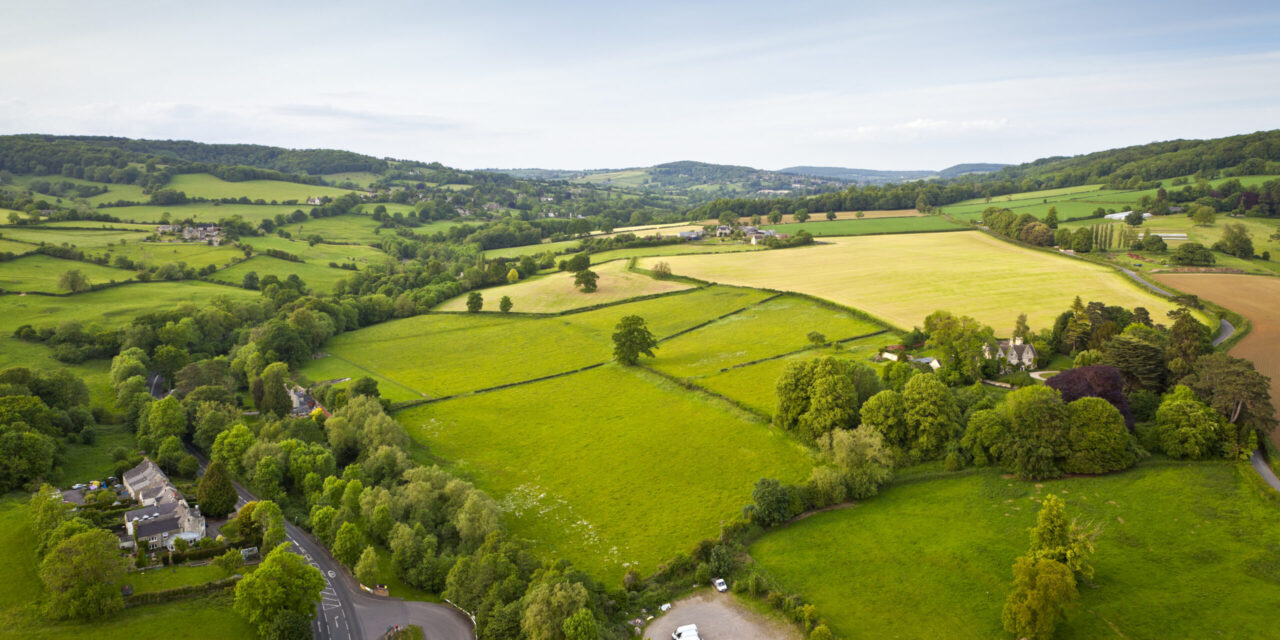
The Cotswolds farmland market showed strong resilience during 2025, despite a range of external factors influencing supply, demand and pricing.
New research published in the Savills annual farmland market report showed the supply of marketed farmland fell by 19 per cent across the Cotswolds region last year.
In total, 15,227 acres were marketed across Gloucestershire, Oxfordshire, Warwickshire, Wiltshire and Worcestershire, compared to 18,685 acres in 2024.
Notwithstanding, supply was still higher than the five-year average in the region, and in line with the 2012-2016 pre-Brexit average for the Cotswolds.
Values held firm overall, but there was striking disparity between different types.
Arable land commanded an average of £10,000 to £13,000 per acre, whilst pasture traded at £8,000 to £10,000 per acre.
In the Cotswolds, buyer diversity was a key feature of the 2025 market, encompassing roll-over buyers and farming businesses, along with lifestyle purchasers and environmental investors.
For the first time since 2022, farms sold to buyers using bank finance, as interest rates fell to more viable levels.
Farmers were the largest buyer group of farmland (45 per cent), with 82 per cent acquiring to expand.
The proportion of non-farmer buyers eased back to 40 per cent, whilst institutional and corporate buyers rose to 11 per cent.
Cash remained dominant and funded 82 per cent of purchases, while the motivations behind sales remained diverse and included retirement, probate and the disposal of non-core assets.
Philip Hoare, head of Savills rural agency in Central England, said: “Farmland is a secure and fundamentally long-term asset class; with less than 1 per cent of the total available agricultural land in Great Britain publicly marketed each year.
“Farms and estates are often owned by successive generations of families, institutions, and organisations, and are either farmed in-hand or tenanted (30 per cent of the sector).
“Changing land use can be a long-term game too, for example, achieving development opportunities can take up to 15 years, if not longer.
“Historically, farmland ownership has been rewarding for many long-term owners, and the accelerated pace of climate and demographic change, alongside evolving policy, suggests this will continue.”
© Western Whistle (powered by ukpropertyforums.com).
This article and its contents are the intellectual property of UK Property Forums and may not be reproduced, distributed, or used in any form without prior written permission. The views expressed are those of the author(s) and do not constitute legal or professional advice.