





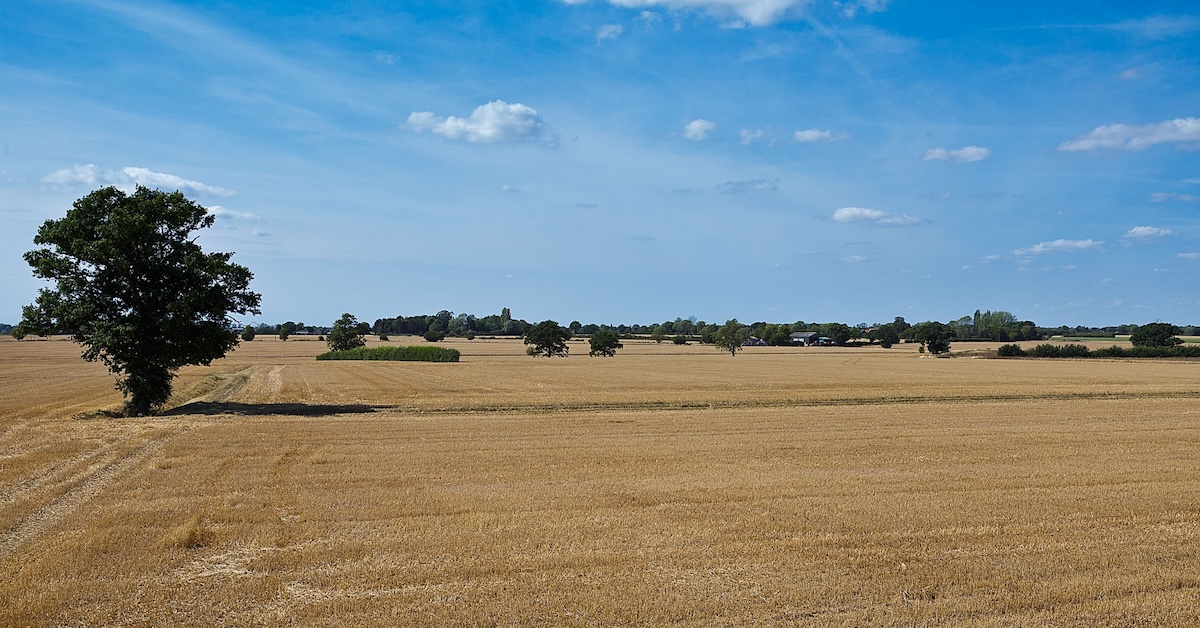
Last year, the East of England saw just over 17,000 acres of farmland being publicly marketed according to the Savills farmland survey.
Whilst the research showed large variations, the value of prime arable land decreased by an average of 4.4 per cent across the region to £9,481 per acre. 12 months ago, the figure was £9,914 per acre.
In the East of England, the total size of publicly marketed farmland was 17,378 acres. The region with the most publicly marketed land was Essex with 4,928 acres. This was followed by Cambridgeshire (4,493 acres), Bedfordshire (2,882 acres), Suffolk (2,290 acres), Norfolk (1,515 acres) and Hertfordshire (1,216 acres).
Jamie Elbourn, associate in the rural agency team for Savills in Essex, said: “Overall the UK witnessed a 12 per cent drop in farmland coming to the market in 2025 – so the figures are not unexpected. What it does show is that despite some significant economic and political headwinds, farming businesses in the East of England remain largely resilient.
“Despite the well documented changes to inheritance tax and other challenges squeezing profits, we’ve not seen a surge of farmland come to the market. That’s testament to the hard work and adaptability of our farmers.
“Where there’s been more farmland for sale it’s mostly been due to one or two larger sales, or here in Essex we have continued to see a regular stream of smaller scale farming units coming to the market.”
According to the Savills report the UK witnessed a 12 per cent year-on-year fall in publicly marketed farmland to 165,000 acres across 882 properties in 2025. Average farmland values meanwhile dipped by around one per cent.
Looking ahead to how the farmland market might perform for the rest of this year and beyond, Oliver Carr, who leads the rural agency team for Savills in Cambridgeshire, said: “We expect values to remain broadly firm through the next two years before entering a phase of steady growth as policy clarity improves and profitability prospects stabilise.
“On the supply side, the acreage marketed could rise from 2027 as larger farming businesses address inheritance tax liabilities. However, we do not see the acreage returning to pre-2000 levels.
“Historically, farmland ownership has been rewarding for many long-term owners, and the accelerated pace of climate and demographic change, alongside evolving policy, suggests this will continue.”
Image: Savills
© Eastern Echo (powered by ukpropertyforums.com).
This article and its contents are the intellectual property of UK Property Forums and may not be reproduced, distributed, or used in any form without prior written permission. The views expressed are those of the author(s) and do not constitute legal or professional advice.