









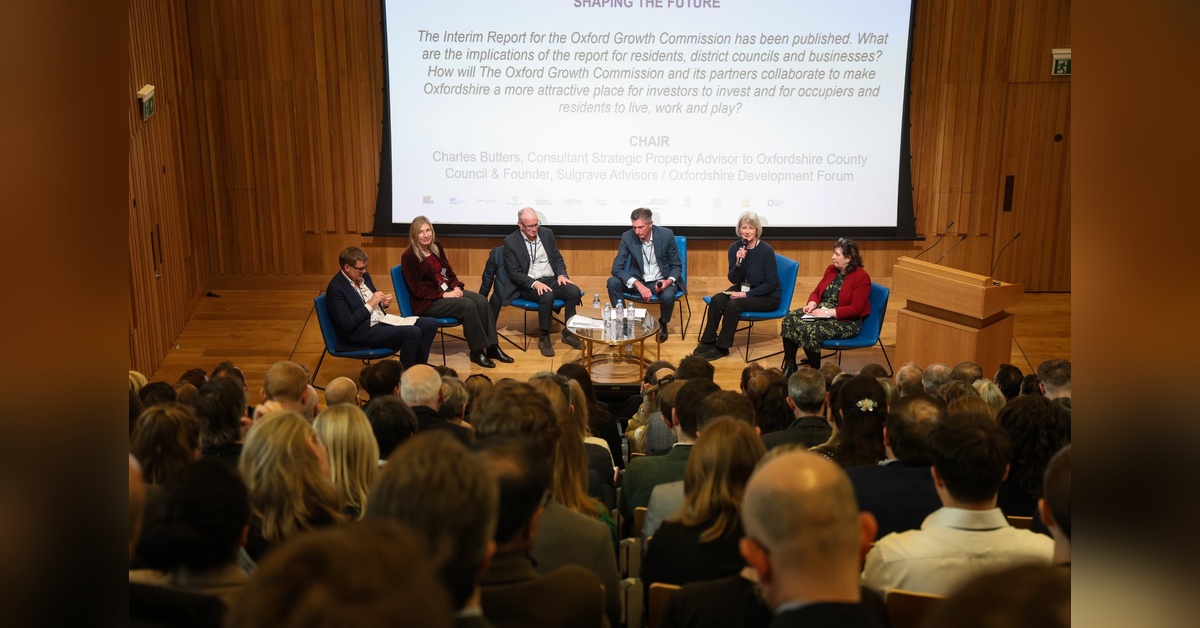
A sold out crowd of around 250 property professionals crowd gathered at Trinity College, Oxford for the annual OxPropSummit event. Alfie Morse reports the highlights from the day’s seven main sessions.
Neale Coleman CBE, former advisor to Jeremy Corbyn, and Chair of The Oxford Growth Commission, spoke on his current role.
The session was chaired by Charles Butters, consultant strategic property advisor to Oxfordshire County Council and founder of Sulgrave Advisors.
Mr Coleman spoke on what needed to happen to unlock Oxfords potential, he summed up the core values needed in four words: “Pace, culture, collaboration and strategy.”
He went on to speak on the OGC’s interim report, saying that the failure of the Oxfordshire 2050 plan was: “a missed opportunity”, and went on to say that housing delivery in Oxford was: “very disappointing”.
Another point Mr Coleman highlighted was the Governments decision not to support Councils with a Mayoral strategic authority, which he said was: “Very regrettable” He also summed up that development in Oxford needed to change: “Things need to be done quicker”, highlighting Section 106 agreements as an example.
He also spoke on Chancellor Rachel Reeves’ latest announcement for the Government to support an Oxford Development Corporation, saying: “I do think it’s important”.
The session was then opened up into a panel, Olga Kozlova, director of innovation at the University of Oxford, and Equinox, initially spoke about Oxfords advantages, specifically its creation of many unicorn companies. Phillip Campbell, development director for Milton Park, spoke about Mr Coleman’s interim report, describing it as: “game-changing”, he then went on to say, “speaking for the whole development community, I’m grateful for Neale’s input”, saying the report would provide: “a really good platform for action”
Cllr Liz Leffman, leader of the Council for Oxfordshire County Council, spoke on issues she felt Oxford suffers from, namely the entrance into Oxford from the railway station being outdated, the main building through which people enter was built in the 1980s, which she said: “Hadn’t been renovated since”, alongside the square being: “messy”.
Cllr Leffman then went on to ask: “What about the rest of the county? Because it’s not just about Oxford”, as there are: “innovative businesses all around the county” in her view, she went on to ask: “How do we encourage young people, who live in places like Didcot or Abingdon, to be part of this economy?”, making the point that: “It isn’t just about Oxford, it is about Oxfordshire”, she highlighted: “the right infrastructure, the right travel connections” as key components for the growth of the County.
Cllr Susan Brown, councillor and leader of Oxford City Council, responded: “Oxford City is actually crucial, in terms of the economy to the rest of the county”, Cllr Brown went on to discuss Oxford City Council’s recent work with the University of Oxford: “We asked Government to set up the Oxford Growth Commission, because we recognised that both the developers, but also for local residents, there were a lot of blockers in terms of particularly infrastructure”.
The panel answered questions from the audience, each panel member was asked for their favoured unitary option, Mr Campbell mentioned that he was excited to see the embrace of LGR (Local Government Reorganisation), and Cllr Leffman, despite not mentioning a specific option, noted that there would need to be a county-wide approach.
The Ellison Institute of Technology (EIT) is developing quickly in Oxford, with half a million sq ft of scientific space leased in 2025, and more plans on the way.
The second session was chaired by Laura Ludlow, partner at Mills and Reeve. Matt Abney, senior director of real estate at EIT, opened the session by asking: “What are we doing? What is EIT all about?”, he came to the answer: “Discovery into impact”.
Mr Abney spoke on the origins of EIT. During COVID, Larry Ellison, co-founder of Oracle and EIT, became interested in the area due to the University’s involvement in vaccine production, saying: “We need to have a footprint there”.
The campus was eventually designed by Foster and Partners, with the aim for: “spaces that are highly collaborative” due to the campus being adjacent to the Oxford Science Park.
EIT’s focus areas were outlined as AI and robotics; health, medical science & generative biology; food security, and climate change.
Mr Abney went on to speak about the campus design, describing it as having an: “all encompassing approach”, with unique designs, such as an auditorium underneath a water feature, Mr Abney said: “On this side of town, there’s really not anything like this”, seeing the opportunity to create something new as a great opportunity to attract interest.
Another development Mr Abney spoke about was the Eagle and Child Pub, which EIT are renovating in the City Centre, to be a: “landing pad” for faculty and staff, having worked with St Johns College to acquire the site, which was shuttered since 2020.
Sophie Bannister, director of real estate at EIT, spoke on EIT’s growth. The project was initially expecting a capacity of 300 people on the campus, quick growth changed this, and now plans are estimated to be in the thousands, with the latest plans for an auditorium reaching a 750-person capacity.
The panel responded to questions from the audience, when asked if there was an endowment in place, Mr Abney responded: “Not an endowment in a traditional sense, there is a financial commitment from Larry for the future of EIT” which is £10 billion over the next 10 years.
The third session of the day discussed how new homes can support well-connected communities, using Heyford as an example.
The panel session was chaired by Rob Allaway, managing director of Devcomms. Gavin Angell, development director at Dorchester Living, opened by agreeing with Neale Coleman’s earlier statement, that the failure of the 2050 plan was a missed opportunity. Mr Angell then went on to discuss the Heyford development, for which he was keen to ensure provisions such as schooling, shops, and other retail amenities, saying: “We want the best outcome”.
Harrison Symonds, architect and associate at Proctor & Matthews Architects, discussed the development further, mentioning density as important to support mixed uses- as an example he described a shop as requiring roughly 1,500 local customers in order to do business.
Mr Angell then went on to discuss the targeted demographics of the development, mentioning that 80 percent of interest is from people already located in a 10-mile radius of the development, describing this as: “underlying demand”.
Hannah McCarthy, head of partnerships at Octopus Energy, spoke about energy provision for the development, on the topic of the cost of solar power, she said it had: “dropped 99.9 percent since 1975”, making it more viable.
The panel then took questions from the audience, when asked to respond to accusations that there have been failures to provide amenities, Mr Angell said: “We are supporting those amenities” explaining: “They don’t need to be delivered this early into the scheme”.
The Warneford Park development looks to be a promising campus for mental health care, with the 950,000 sq ft project projected to be a big contribution to Oxfords innovation ecosystem.
This session was chaired by Nigel Tipple, director at Nigel Tipple Associates. Eric Parry CBE, founder and principal at Eric Parry Architects, opened the session by discussing the sites past as a 200-year old establishment, from 1826 through to 2026.
Mr Parry then discussed the masterplan for the site, setting out that visitors would mostly be inpatients and staff, the landscape would involve open recreation spaces in the centre of the two-storey wards, which have already had development around them, he went on to say there would be a “warmth” to the materials used in the development, mentioning: “our intention to improve the lot of listed buildings”.
Rob Bale, consultant psychiatrist and chief operating officer for mental health and learning disability for NHS-Oxford Division, spoke on his work on the site, having been there for 23 years, he went on to say that currently the building isn’t fit for purpose, which was really noticeable during the COVID pandemic, given the vulnerable nature of the patients, he thought this was a pertinent issue.
Heidi Johansen-Berg, associate head of division (research and innovation) medical sciences for the University of Oxford, spoke on the need to bring together clinical care and research, which at Warneford would happen at scale, which she described as unique. She went on to discuss the usual separation of physical and emotional states when it came to mental health, feeling that this development could change that.
See the days afternoon sessions here
Our photo gallery for the day is here
© [2026] UK Property Forums. All rights reserved.
This article and its contents are the intellectual property of UK Property Forums and may not be reproduced, distributed, or used in any form without prior written permission. The views expressed are those of the author(s) and do not constitute legal or professional advice.