












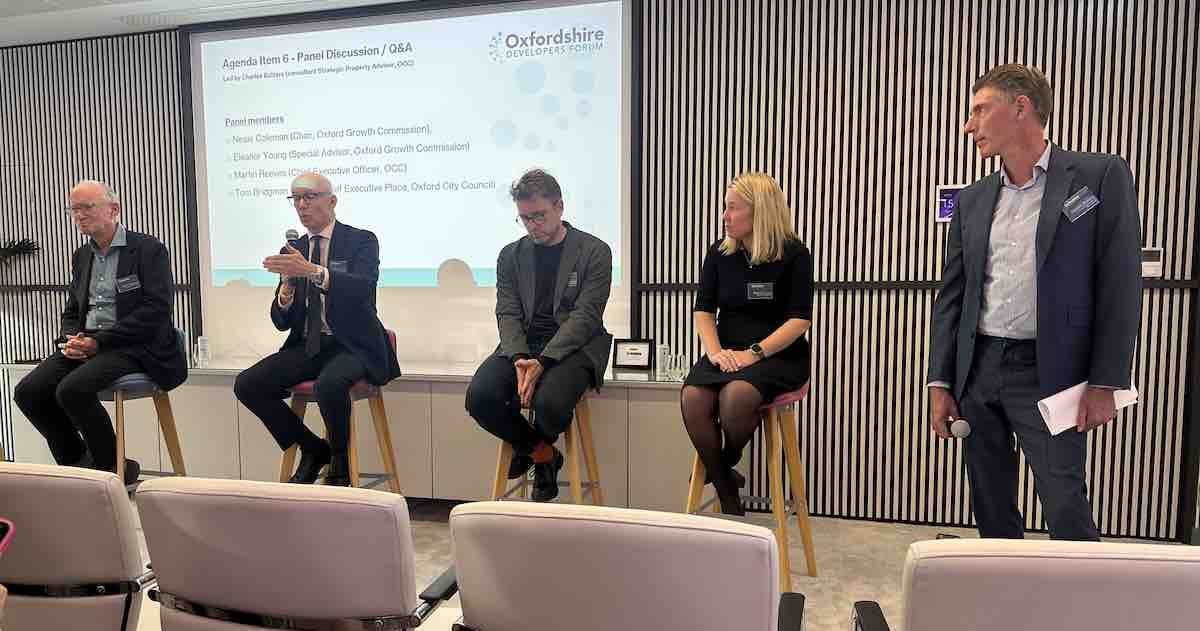
Some of Oxfordshire’s most important developers and investors came together for the latest quarterly meeting of the Oxfordshire Developers Forum. UKPF consultant Hugh Blaza was among them and walks us through the debate.
At the third gathering of the Oxfordshire Developers Forum, hosted by ARC Oxford at its Works meeting centre on the Oxford Business Park, those charged with delivering the region’s colossal potential presented their update to a gathering of leaders from the development community.
Neale Coleman (far left in image) has been appointed by the Government as chair of the Oxford Growth Commission to convert the opportunities that have been identified – which, he says, rival only those of Cambridge and the Bay Area in the US – into a thriving and prosperous reality, which will benefit not only the immediate region but the UK in its entirety.
Neale and the panel of leaders explained how they see the building blocks for growth being put in place- agglomeration. In other words, a concept whereby all the opportunities will be combined in ways which have been recognised as fundamental to delivery.
Tom Bridgman, deputy chief executive place, Oxford City Council, provided an update on the Cowley Branch Line, explaining how it will unlock between 5,000 and 10,000 homes along its route, along with 2.5 sq m of commercial space.
With financial support from local business, receipts from CIL and s106 agreements and backing at ministerial level, it can only be a matter of time before the trains will be arriving at Platform One.
Pete Brunskill, who is leading rail development and place shaping at Oxfordshire County Council, has a wider strategic brief and is charged with developing and modernising rail services in the entire region.
His mission: to ensure the delivery of OxRail 2040 vision, the backbone required to create a world-class integrated, accessible and sustainable transport system and facilitate movement – and therefore growth – across the piece.
Neale Coleman’s key presentation confirmed so much that we already know but gave us a considerable boost of confidence that these things can actually happen. The essential and critical infrastructure issues are being addressed (Thames Water are now on board and the energy companies are engaged) and with Homes England involved in the developments around Bicester, it is anticipated they will look to the potential elsewhere in the region.
Neale has been on a fact-finding mission since his appointment and will be delivering his interim report to ministers this November. For it to be ignored, given the potential it is likely to present, seems unthinkable, but we need to know how (and when) it will all be delivered.
As he put it: “Oxfordshire is an incredible national asset, but it is much under-appreciated.”
And, he suggests, the existing local government structures are no longer fit for purpose: “The case for local government reorganisation has been made and we need to get on with it.”
To answer that, at least in part, the meeting heard from Martin Reeves, chief executive of Oxfordshire County Council, who joined Charles Butters’ panel of speakers to explain how essential it is that local government reorganisation and the appointment of a Mayor for the wider region gets done and dusted as swiftly as possible.
Then the creation of a strategic spatial plan and the inception of centralised administration and devolved high-level decision making will kick in to convert the conceptual into reality.
But messaging is essential to the success of the project. Those living and working in the area understand the potential and the frustrations but getting buy-in from the major international players, who are likely to find all that they seek in the region, will be one of the keys to unlocking it for the benefit of all.
The switched-on members of the development community are fully aware of the potential and are already investing in it.
And they have experience; they want to be a part of the process and, working at the sharp end of delivery, their ‘polite(!)’ contributions to the debate must be welcomed for their practical and realistic experience.
In the words of Anna Strongman, chief executive of Oxford University Development (OUD): “I hope the growth commission will remove the constraints we labour under so the development community can release its potential.
“Yes, we want to partner with the public sector so we can help them deliver.”
An offer that the councils seem more than willing to accept.
© Thames Tap (powered by ukpropertyforums.com).
Sign up to receive our weekly free journal, The Forum here.