










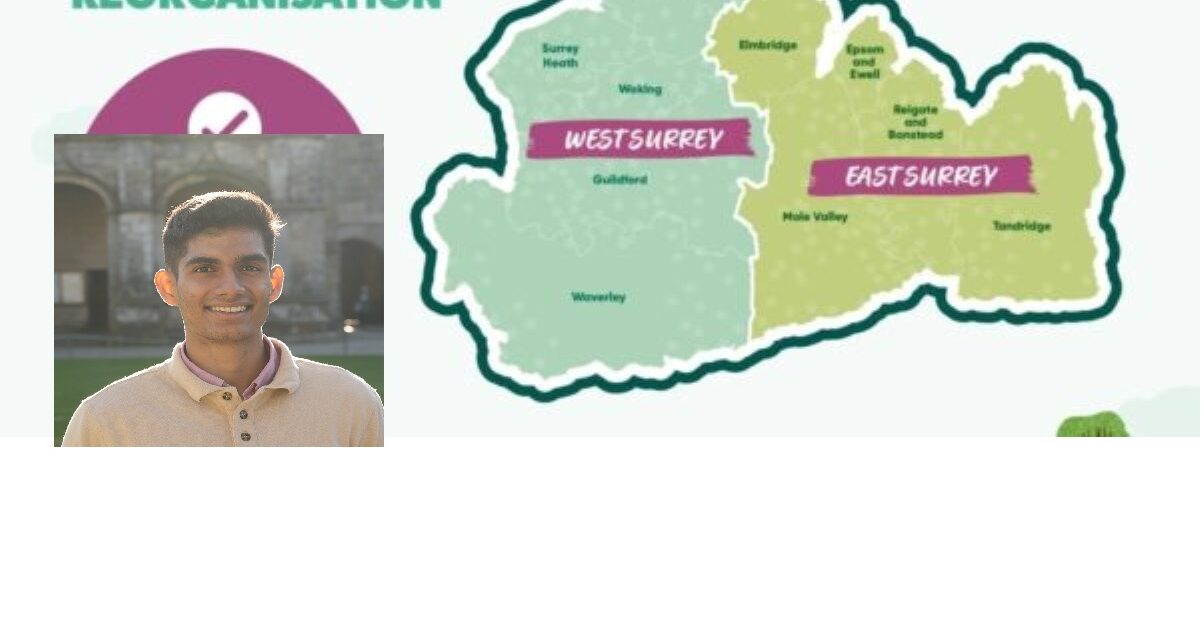
Akshay Joshi – Savills Summer Student (2026), covers the impacts of Local Government Reorganisation and Planning Reform on Surrey.
Savills’ annual Spotlight on Planning 2026 summarises what might be the latest pivotal moments with the English Planning system (see here https://www.savills.co.uk/research_articles/229130/391817-0 ). A wave of reform is reshaping housing targets and ushering the resurgence of strategic planning. Surrey sits at the sharp end of both, with local government reorganisation (LGR) well underway across a county where roughly three-quarters of the land is Green Belt. Reconciling the tensions between LGR and Green Belt pressures will define Surrey’s planning story over the coming years.
The 2024 NPPF’s reinstated mandatory targets and tougher standard method have sharply pushed housing requirements. Land supply is the first casualty as most English authorities can no longer prove a five-year supply, tipping decisions onto the tilted balance. Savills projects that 45 per cent of English authorities will fail the Housing Delivery Test in 2026 (up from 35 per cent the year before), with 30 per cent triggering the presumption in favour of sustainable development. Surrey sits squarely within that trend, with rising speculative applications and pressure to release Green Belt land. Much of the contest now plays out over a site’s Grey Belt status, and schemes that clear it must still meet the Golden Rules. It is predicted that such contestation will continue to rise.
Where local determination stalls, the appeal route has become an increasingly reliable alternative. The likelihood of an appeal being allowed has climbed steadily since 2021 and has been helped by a faster, digitally-led process. However, local determination has moved the opposite way, with decision times for major applications nationally now approaching 57 weeks. Here, applications are being held back by under-resourced planning teams and drawn-out consultation. In Surrey, where speculative applications for Grey Belt-contested schemes are already common, this gap gives applicants good reason to build an appeal strategy (and factor appeal costs) from the outset.
Plan-making compounds these pressures. Nationally, 204 local authorities (LA) risk entering 2027 without an up-to-date plan. This means that they will miss the December 2026 deadline for submission under the legacy system. Surrey’s 11 district and borough councils sit at different points against that same deadline, which means that the two incoming unitary authorities will inherit a patchwork of plan timetables on Vesting Day – 1 April 2027 (it presently looks like only Tandridge DC will submit a new Plan just before Christmas). Buckinghamshire’s 2020 experience of unitarisation will be a case to learn from. Six years on, the Council still has no adopted Local Plan and continues to rely on plans inherited from its four former districts. Surrey’s LGR has, to its credit, moved faster than anywhere else; however, as we see in Buckinghamshire, that headstart alone won’t guarantee success.
Spatial Development Strategies (SDSs) are positioned as tools to facilitate this transition, with SDSs setting sub-regional housing numbers and freeing local plans to focus on site allocation. This sequence is most effective when the strategic tier arrives first. However, Surrey’s timeline runs the other way, with the unitary authorities inheriting the current patchwork of plans. Simultaneously, uncertainty is compounded as the body that would write Surrey’s SDS remains undecided, with it being unclear whether Surrey will get a Mayoral Strategic Authority of its own. Until the SDS is developed (likely no sooner than 2029), Surrey authorities will keep facing speculative applications without a strategic framework. Even once an SDS does exist, aligning it with infrastructure will be its own important challenge, notably utilities and transport.
Many of these key challenges will remain unresolved before Vesting Day. Until they are, the system will keep working itself out one appeal at a time, and development schemes in Surrey will still start with the same two questions: does the authority have an up-to-date plan, and can it demonstrate a five-year land supply? For several Surrey authorities, the honest answer to both will remain a ‘No’.
Key Sources: Savills (2026) articles titled ‘Spotlight on Planning 2026’; ‘Local Plan Pathways’; ‘Planning Data Update’; ‘Strategic Planning’

© 2026 UK Property Forums. All rights reserved.
This article and its contents are the intellectual property of UK Property Forums and may not be reproduced, distributed, or used in any form without prior written permission. The views expressed are those of the author(s) and do not constitute legal or professional advice.