





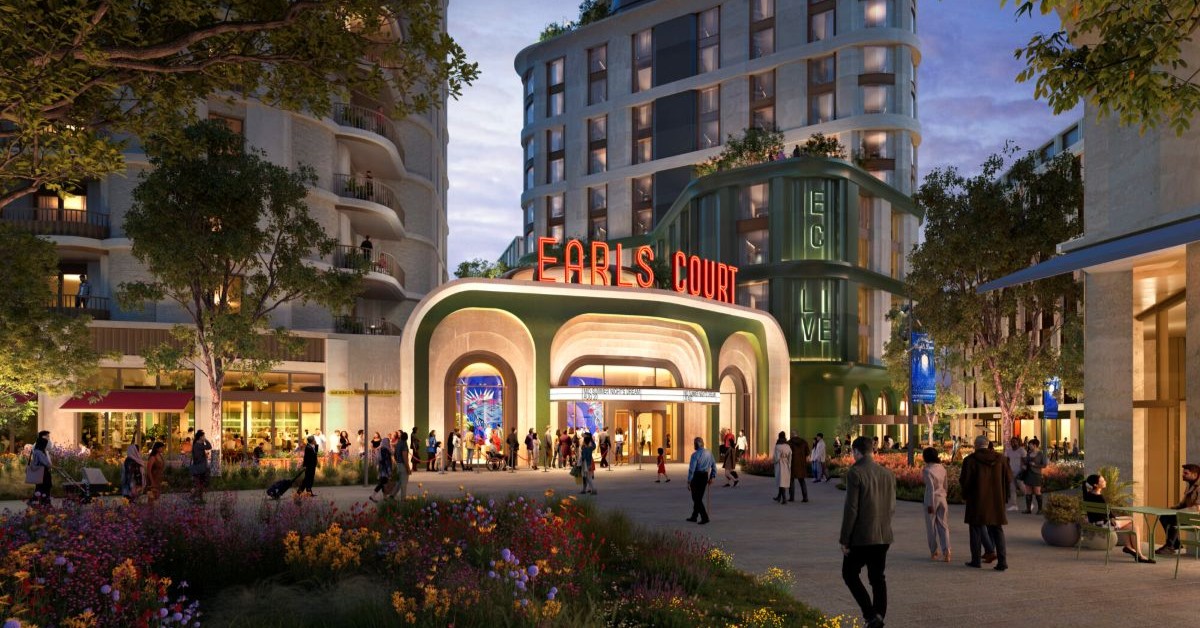
The ambitious £10 billion masterplan for Earls Court has been approved by the Planning Committees of Hammersmith & Fulham and Kensington & Chelsea, setting the stage for a transformative development in London.
This project aims to revitalise Earls Court as a global destination, bringing approximately 4,000 homes, cultural venues, and an innovation ecosystem within 20 acres of landscaped public realm and green space. The development is expected to generate 23,500 jobs and contribute £3 billion annually to the UK economy.
The Earls Court Development Company (ECDC) submitted hybrid planning applications in 2024, seeking outline permission for the masterplan and detailed permission for six buildings in the first phase. With approvals secured, ECDC is now focused on mobilising to deliver these initial buildings. The project emphasises a collaborative partnership between the public and private sectors to expedite the creation of new homes and public spaces.
Rob Heasman, chief executive of ECDC, expressed the project’s vision: “Our plans will restore Earls Court as a global destination, a place for ingenuity, for the extraordinary, and for people to wonder.” He highlighted the importance of ambition, partnership, and patience in bringing such a large-scale project to fruition, acknowledging the four years of community engagement that shaped the plans.
Jamie Ritblat, founder and executive chairman of Delancey, described the approval as a significant milestone, emphasising Earls Court’s role as a beacon for London’s future. The development will create a new centre for the UK’s climate innovation sector and deliver substantial economic benefits, including 23,500 jobs and £3 billion annually to the UK economy. Three new cultural venues will enhance Earls Court’s status as a destination for unique performances and experiences.
Graeme Craig, director and chief Executive of Places for London, highlighted the project’s significance as a model for connected brownfield land development, underscoring Places for London’s active role in shaping the city’s future. The project includes training facilities for the next generation of construction workers, further contributing to London’s development needs.
The masterplan, shaped by extensive engagement with residents, businesses, and community groups, aims to reflect the priorities of those familiar with the area. It includes innovative housing solutions, such as a new tenure to support the ‘squeezed middle,’ and features designs by renowned architecture practices. The tallest building, designed by Sheppard Robson, will be a 42-storey landmark reshaping the west London skyline.
Sustainability is a core focus, with landscape architects SLA and Studio Egret West designing a climate-resilient public realm that includes over 1,000 new trees and an 85 per cent increase in biodiversity. The development will feature a zero-carbon energy network and aim for zero operational carbon from first occupation.
Earls Court will also become a key centre for climate innovation, with 2.5 million sq ft of workspace supporting startups, scale-ups, creative industries, and global firms, creating around 12,000 on-site jobs. With detailed permission for the first phase secured, early construction is expected to begin in 2026, marking the start of a nationally significant project that will have a significant impact on the UK economy and job market.
© London West (powered by ukpropertyforums.com).
This article and its contents are the intellectual property of UK Property Forums and may not be reproduced, distributed, or used in any form without prior written permission. The views expressed are those of the author(s) and do not constitute legal or professional advice.