










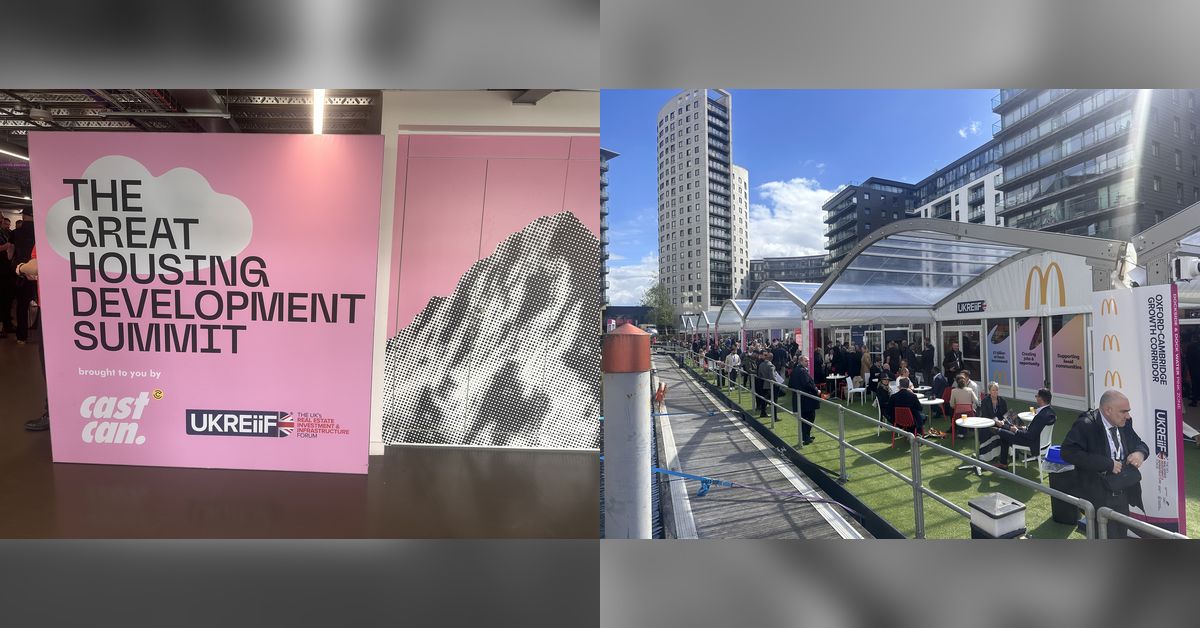
UK Property Forums was invited to UKREiiF to moderate a Round Table, exploring the topic of ‘Town Centre First: Turning Brownfield Sites into Homes and Growth’ as part of The Great Housing Summit, which aimed to explore how the UK can build more homes and help solve the housing crisis.
Buckinghamshire Council made use of this platform, with around 16,000 attendees at UKREiiF, to launch the Aylesbury Town Centre Investment Prospectus. The Round Table was an opportunity for a more intimate discussion with 17 other guests to discuss the issues driving town centre regeneration. Buckinghamshire is now starting to engage with the property market and is identifying investment partners who can assist them with their regeneration plans.
Margaret Collins, Director at GC Insight, commented:
“I welcome the opportunity to highlight the benefits of bringing forward housing on brownfield sites within town centres. In addition to supporting employment during both the construction and operational phases (the latter if part of a mixed-use scheme), these developments contribute to the local tax base. Importantly, they also increase footfall and local spending, helping to sustain town centre vitality.
Housing-led regeneration can have wider catalytic impacts, unlocking further investment as confidence improves and previously derelict or underused sites are brought back into active use. By increasing activity beyond traditional business hours, particularly in the evenings, town centre living can also improve perceptions of safety, contributing to reduced crime and creating more vibrant, well-used places.”
Hannah Brynant, Director, Arrow Planning, commented:
The discussion highlighted the importance of a clear vision, supported by robust planning frameworks and consistent decision-making, to help create investment-ready opportunities. We also explored the role that well-designed higher-density development can play in supporting town centre regeneration, increasing footfall, and improving the viability of infrastructure and place-making investment. Ultimately, if we are to unlock more brownfield sites and establish a sustainable delivery pipeline, planning policy, viability expectations and investment objectives must be better aligned.
Discussion highlights
All attendees were encouraged to talk about recent examples they have been involved with and contribute to the core talking points:
. The role of public/ private partnerships
. How councils can package sites to be investment ready
. Steps to be taken to make brownfield sites progress faster
. The implications of integrating higher density into town centres schemes
. How to ensure that growth benefits everyone.
Some clear themes emerged, such as the need for early engagement on sites to ensure they are packaged to be investment ready. This packaging would need to include engagement with the local community and stakeholders to ensure that growth flows from top to bottom.
Finally, there was a large hint from all the Round Table attendees that success can be measured by the ability of the ‘leaders’ to create strong relationships.
Round Table Attendees
Hannah Bryan, director, Arrow Planning
Cllr Steve Broadbent, leader, Buckinghamshire Council
Zina Etheridge, chief executive, Buckinghamshire Council
Shabnam Ali, head of regeneration, Buckinghamshire Council
Steve Bambrick corporate director, Buckinghamshire Council
Paul Silver, chief executive, Dorchester Living
Edward Banyard-Smith, partner, Farrer & Co
Margaret Collins, director, GC Insight
Jamie Hunter, development director, Hill Group
Ishdeep Bawa, director, IB Real Estate
Ellen Vernon, assistant director plan programme, LGA
Kieran Gregson, associate development director, Lovell Strategic Land
Martyn Saunders, director, Metro Dynamics
Chris Williamson, president, RIBA
Matthew Bird, regional managing director, SNG
Andy Mason, contractor, Yorkshire Building Society
and
Matthew Battle, managing director, UKPF

© 2026 UK Property Forums. All rights reserved.
This article and its contents are the intellectual property of UK Property Forums and may not be reproduced, distributed, or used in any form without prior written permission. The views expressed are those of the author(s) and do not constitute legal or professional advice.