











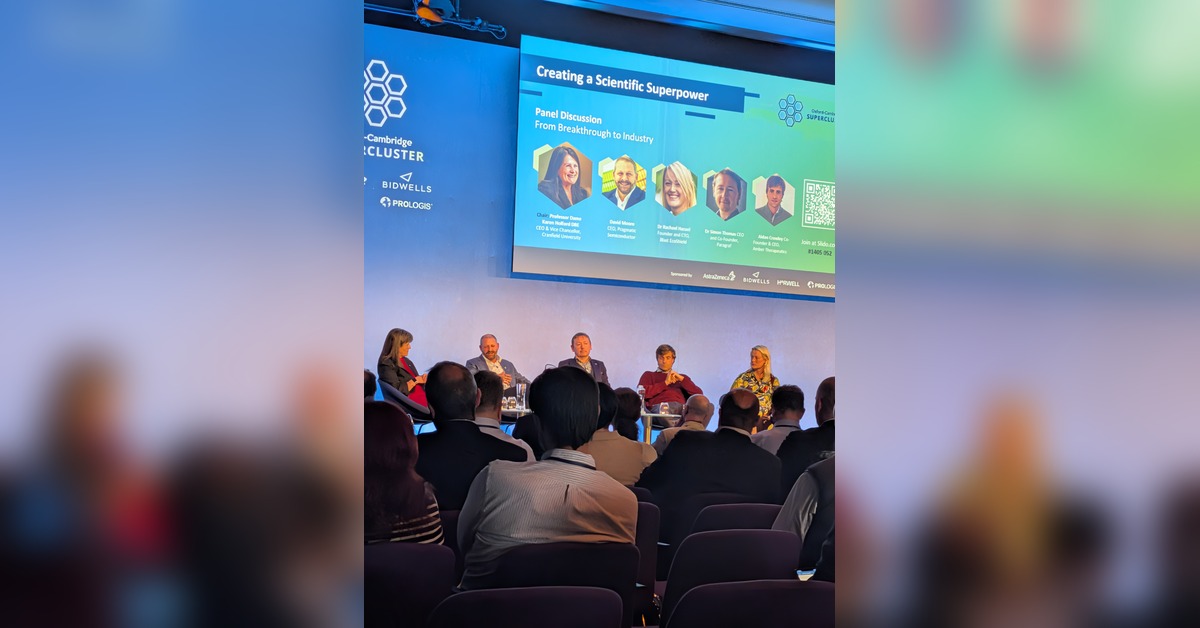
Yesterday, members of UKPF attended the fifth annual “Creating a Scientific Superpower” conference, Alfie Morse reports on the standout sessions of the day.
First keynote: Lord Vallance
The day opened with a keynote from Lord Vallance, where he outlined the Oxford Cambridge growth corridor as being: “A nationally significant growth opportunity”, then going on to answer questions submitted by the audience, notably, when asked about how to increase scale – a key theme of today’s discussions – he highlighted “Early procurement”, saying that it “unlocks private sector confidence”.
First panel discussion
The first panel discussion of the day covered: “Why global investors are committing to OxCam”. Lord Jason Stockwood, Minister of State for Investment, described the potential of the growth corridor, saying: “This will change the trajectory of our country over the next century if we get things right”, and that the positive impacts of the project are: “Things that are going to last for multiple generations”.
Lisa Flashner, chief operating officer at EIT, said: “We can’t expect Government to deliver it all” noting that in the example of the Cowley Branch Line reopening, companies and Oxford University came together to help get it over the line.
Paul Weston, senior vice president at Prologis, praised collaboration in the corridor, saying: “Cross-party working has been exemplary”.
When asked about EIT’s five-year vision, and aims for achievement, Lisa said: “We really have addressed some global problems”.
Second panel discussion
The second panel: “Turning growth ambition into delivery”, involved a huge announcement – Matthew Pennycook MP, Minister of State at the Ministry of Housing, announced the Governments intention to create a Greater Cambridge Development Corporation (INSERT LINK), mentioning that this would bring a number of unique powers, such as: “direct access to central Government”, in order for greater efficiency in development.
Mr Pennycook went on to explain that the Development Corporation would align with the administrative boundaries of Cambridgeshire, however there is still an aim to: “Work with local partners within and outside the boundaries”.
Peter Freeman, chair of the Cambridge Growth Company, mentioned his continued work in Cambridge, saying he has been: “Going up every week for nearly three years”, and went on to praise the areas receptiveness to institutions integrating, describing it as the: “Least NIMBY place I’ve ever worked in”.
Mr Freeman went on to describe the importance of improving Cambridge’s infrastructure, saying: “We need to make it the most liveable city in Europe”, and: “We’ve already got the gold in Cambridge, but we need to connect it to the infrastructure”.
Professor Deborah Prentice, vice chancellor of the University of Cambridge, discussed a pilot project for an apprenticeship clearing house, to allow small businesses to access local talent without huge startup costs.
Neale Coleman MBE, chair of the Oxford Growth Commission (OGC), said: “I’m a great believer in getting stuff done”, going on to say that was a large part of what the OGC spent time on, outlining the Cowley Branch Line as an example, he then said: “We’re now working really hard on the practical implementation of that rail scheme”.
When asked about the necessity of an overall spatial plan for the corridor, Dr Andy Williams, Chair of the Oxford-Cambridge Supercluster Board (and Chair of the discussion), said: “It needs to be something we work on together”, Mr Pennycook said: “I’m a pragmatist, I want to get things moving quickly”. Mr Coleman said: “We absolutely need to be looking forward as soon as possible”, he then said “I do think we need a spatial plan”, but that it would need the right leader in place.
Third panel discussion
The third panel discussion: “Connecting OxCam and the Northern Corridor”, involved Steve Rotheram, mayor of the Liverpool City Region, and Tom Riordan CBE, envoy for Northern Growth.
Mr Riordan said: “There’s been a view that geography and innovation are mutually exclusive” but argued the Northern corridors strength of its universities, which issued 45 patents annually, saying: “Although it’s more dispersed than Oxford and Cambridge, other countries would kill for those numbers”, then going on to say: “The real prize is if we can get that extra cylinder on the engine by doing these things together”
Mr Rotheram then went on to discuss Liverpool’s key assets, notably its dark fibre cables, mentioning that the city’s ownership of the cables attracted companies to base themselves in the city – given the value the cables provided, Mr Rotheram said: “The future has to be about those emerging technologies”, adding that Liverpool had seen significant improvement in areas like graduate retention, going from being in the countries bottom 10 in 2017, to the top three currently.
When asked about the East West Rail project’s significance, Mr Rotheram described it as: “Really important”, describing it as a ‘catalyst’, and that the connectivity it would bring the Northern Arc could provide it with greater Gross Value Added (GVA) than OxCam.
Mr Riordan highlighted the importance of the Northern Arc and Oxcam’s collaboration, saying: “We should be advocates for each other”, but also outlined the differences between the two, mentioning OxCam benefitted from global reach, but doesn’t possess the Northern Arc’s strong water and energy connectivity.
Fifth panel discussion
The fifth panel discussion: “From breakthrough to industry”, had a panel arranged in an interesting order – from right to left the panel members were in ascending order of the establishment of their business, furthest to the right was Dr Rachael Hazael, chief technology officer at Blast EcoShield Ltd – established this year, then Aidan Crawley , chief executive and co-founder of half-decade old Amber Therapeutics, Dr Simon Thomas, chief executive and co-founder of decade-old Paragraf, and finally David Moore, chief executive of Pragmatic Semiconductor, founded in 2010.
Dr Hazael described the biggest challenges working in a new spinout, saying: “To make sure we’re not being shoehorned into one particular area”, also saying: “We are approaching this problem with a sector that really likes what has always been there”.
Mr Moore was asked what he would do if he was starting in his industry again, he said: “At the juncture I joined it was all about getting to scale…making sure we have investor support, the right customers”, then saying a key question was: “Where is the true value of the disruptive technology?”
Mr Crawley then raised some issues his business had had, mentioning that the UK is: “Kind of on our own from a regulatory standpoint” and: “We have to think about getting the best people from America to come over here” in regards to acquiring individuals who perform well at scaling companies. Mr Crawley went on to say that attracting these people can be difficult, given the lower wages domestically, saying: “I don’t think the UK’s in a great position at all”.
Dr Thomas agreed with Mr Crawley, he said: “I would echo Aidan’s thoughts… I would call the UK “The innovation merchant”, but when you move on and you meet those people that can help you grow a real business, it’s magnifying”, he then said: “The way in which we bring talent into the country is not efficient at all”.
A question was posed to the panel about one thing they would change in the UK, in regards to things being slowed down, Dr Thomas mentioned inefficiencies in an NSIA investigation that his company was subject to; whilst he was compliant and agreed that such investigations were necessary, he mentioned that when it happened the company was told it would be three months – it was seven-and-a-half – and an investment had to be put on hold as the investigation started on the day of the investment, which was far harder to manage over the actual timespan of the investigation.

© 2026 UK Property Forums. All rights reserved.
This article and its contents are the intellectual property of UK Property Forums and may not be reproduced, distributed, or used in any form without prior written permission. The views expressed are those of the author(s) and do not constitute legal or professional advice.