










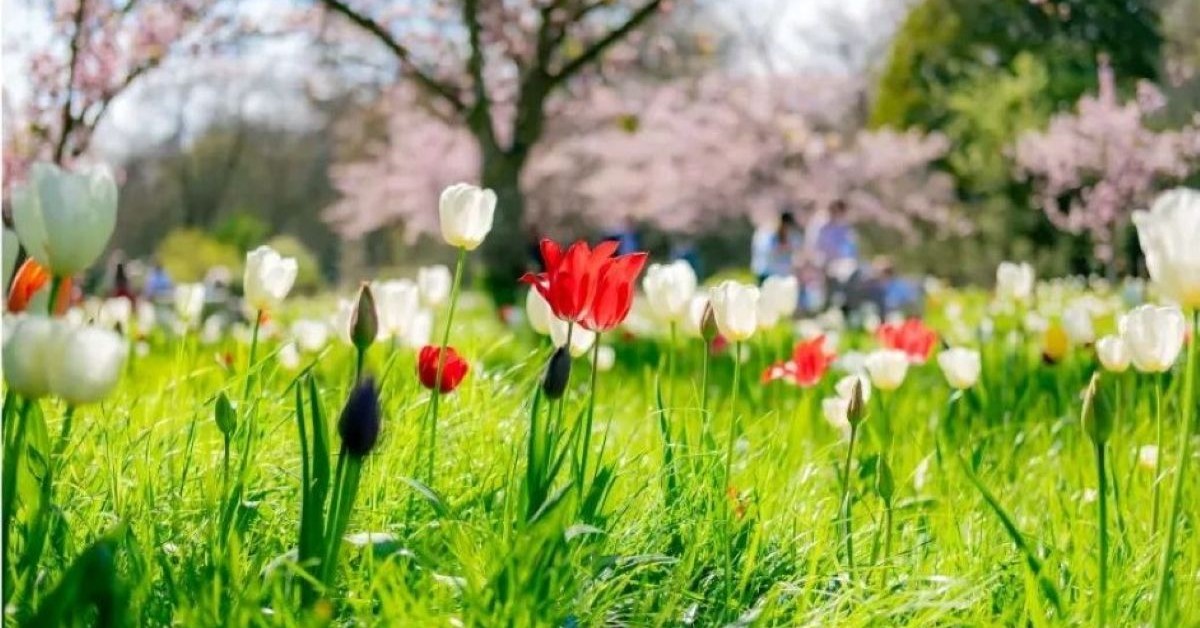
Record-breaking rainfall over the winter, combined with relatively warm temperatures, has produced one of the most spectacular spring blossoms at Kew Gardens, horticulturists say.
The botanic garden in the heart of West London saw a third of its annual rainfall in the first six weeks of winter alone, leading to ‘condensed’ blooms of magnolias and cherry trees lining Kew’s avenues.
The start of spring has also seen peak temperatures 10 °C above the average for early April. And on Wednesday, 8th April, the mercury at Kew Gardens peaked at 26.6 °C, officially marking the UK’s warmest day of the year so far.
The result has been an explosion of colour at the UNESCO World Heritage Site, making it a must-see destination for anyone keen to experience spring blossoms.
However, Kew’s experts warn that the underlying trends behind this seasonal kaleidoscope are evidence of the UK’s changing climate, supported by historic weather station data collected at Kew Gardens since the 1990s.
Thomas Freeth, head of Living Collections Support at Kew, says: “The Gardens are looking truly amazing at the moment, and that is because we have had an exceptionally wet winter, with all that rain soaking into the ground and nourishing the plants.
“At the same time, we have had one of the warmest winters on record and once the weather turned from cloud to sun, all the spring blossoms got condensed, resulting in perhaps the best spring we have seen at Kew in a decade.
“Unfortunately, when we look at our long-term climatic trends, the data is telling us that even with all of that rainfall, it has been one of the warmest starts to the year on record, and that poses a long-term risk, particularly for the 11,000 trees on our site.”
Kew’s horticulturists are increasingly having to deal with the impacts of shifting weather patterns and extreme weather events, such as the heatwaves of 2022 when thermometers peaked above 40 °C. More than 400 trees were lost that year to drought, compared to the average annual loss of 30 trees.
Long-term modelling indicates London’s climate could resemble that of modern-day Barcelona by 2050, and further research indicates between 30 per cent and 50 per cent of Kew’s 11,000 trees will be at risk of being lost to climate change by 2090.
As outlined in Kew’s Landscape Succession Plan, some of the trees most at risk include iconic British species such as English oak (Quercus robur), common beech (Fagus sylvatica) and silver birch (Betula pendula).
Thomas Freeth says: “Everything has bloomed at once and the Gardens are looking magnificent, but we are already seeing signs of mechanical drought across the site and soon, we will start to see the physical signs of stress in our plants.
“The good thing is, though, that as a botanic garden we are well equipped to monitor these effects across a wide diversity of plant species. Our tree collection alone comprises 1,500 species, which is as many as can be found across the whole of the UK.
“And so, we have the capability to closely monitor these species, see which do well, and based on our observations, provide evidence-based recommendations for making our urban forests across London more resilient through targeted species selection for planting.”
Kew’s research indicates plants from Mediterranean and steppe climates are performing better, whereas species historically collected in the moist, montane and cooler parts of the globe are struggling increasingly.
Besides trees, phenology data collected over the past 50 years also show that plants such as snowdrops are now flowering several weeks earlier than they used to, with similar trends observed in daffodils and crocuses, which are now flowering in the weeks right after Christmas.
Bulbs, in particular, are extremely sensitive to rising temperatures, and with one of the world’s largest bulb collections housed at Kew, horticulturists are well positioned to monitor the plants and make empirical observations on the impacts of climate change.
Thomas Freeth adds: “Fundamentally, a tree planted tomorrow is a teenager by the century’s end. We must utilise the knowledge and expertise held by places like Kew to adapt our planting in our cities and gardens, so we are well prepared for the future.”

© 2026 UK Property Forums. All rights reserved.
This article and its contents are the intellectual property of UK Property Forums and may not be reproduced, distributed, or used in any form without prior written permission. The views expressed are those of the author(s) and do not constitute legal or professional advice.